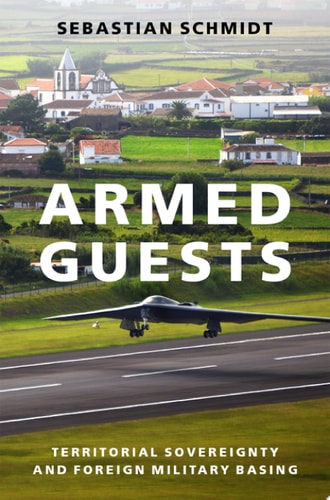
Armed Guests: Territorial Sovereignty and Foreign Military Basing
0
0
As an Amazon Associate and affiliate partner, Menrva Books earns from qualifying purchases. Learn more
Author Description
In the wake of World War II, the United States and its allies developed a new type of security arrangement in which a state could maintain a long-term, peacetime military presence on the territory of another equally sovereign state that, unlike earlier practice, was not tied to occupational regimes or colonial rule. The impact of this development on international politics is hard to overstate, and it has become a constitutive feature of contemporary security dynamics. Despite its significance, the origins of this basing practice have remained largely understudied and unexplained. In Armed Guests, Sebastian Schmidt develops a theory to explain the emergence of this phenomenon, which he calls "sovereign basing," and in doing so, shows how its development fundamentally transformed state sovereignty and the very nature of security politics. He applies concepts derived from pragmatist thought to a historical study of the relations between the United States and its wartime allies to explain how sovereign basing originated through the efforts of policymakers to come to grips with the unique security environment of the postwar era. As he argues, the tools offered by pragmatism provide needed analytical leverage over the emergence of novelty and offer valuable insight into the dynamics of stability and change.Armed Guests is a wide-ranging account of the development of sovereign basing practices in the years before and after World War II. It is a book with significant implications for our understanding of contemporary security politics and the future of basing strategies as well as for broader issues in IR, including the sociological foundations of security strategies, the nature of norms, and the practice of sovereignty.
Menrva's Summary
THE THESIS
How did the practice of long-term, peacetime military basing on the territory of sovereign states emerge as a standard feature of international security after World War II? Sebastian Schmidt, a scholar of international relations, investigates the origins of "sovereign basing" by examining the post-WWII security environment. He argues that this practice represents a fundamental shift in the nature of state sovereignty, utilizing a theoretical framework rooted in pragmatist thought to analyze how policymakers navigated the unique challenges of the postwar era.
THE SCOPE MAP
What You Will Find
- Historical analysis of U.S. military basing relations with wartime allies.
- A theoretical framework defining sovereign basing as a distinct phenomenon.
- Application of pragmatist philosophy to the study of international security norms.
Scope Limits
- The study focuses primarily on the development of these practices during the mid-20th century.
- It does not provide an exhaustive catalog of every global military base currently in operation.
THE AUTHORITY PERSPECTIVE
Experts recognize this work as a significant contribution to the study of international relations and the sociological foundations of security strategies. Readers frequently note the academic rigor of the text and its utility for understanding the evolution of modern geopolitical norms.
Page Count:
306
Publication Date:
2020-01-01
Publisher:
Oxford University Press
ISBN-10:
0190097779
ISBN-13:
9780190097776
International relations
International Security
Military readiness
Military Bases
Armed Forces
Sovereignty
Political Aspects
Diplomacy
Military History
National security
Defenses
Security Studies
Community Tags
Similar Books