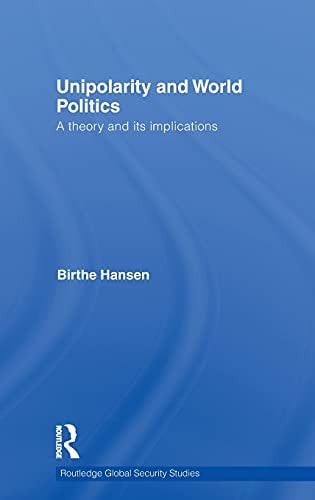
Unipolarity and World Politics: A Theory and Its Implications
0
0
As an Amazon Associate and affiliate partner, Menrva Books earns from qualifying purchases. Learn more
Author Description
This New Book Offers A Coherent Model Of A Unipolar World Order. Unipolarity Is Usually Described Either As A ‘brief Moment’ Or As Something Historically Insignificant. However, We Have Already Seen Nearly Twenty Years Of Virtual Unipolarity And This Period Has Been Of Great Significance For World Politics. Two Issues Have Been Crucial Since The End Of The Cold War: How To Theorize The Distinctiveness And Exceptional Character Of A Unipolar International System? And What Is It Like To Conduct State Business In A Unipolar World? Until Now, A Comprehensive Model For Unipolarity Has Been Lacking. This Volume Provides A Theoretical Framework For Analysis Of The Current World Order And Identifies The Patterns Of Outcomes And Systematic Variations To Be Expected. Terrorism And Attempts By Small States To Achieve A Nuclear Capability Are Not New Phenomena Or Exclusive To The Current World Order, But In The Case Of Unipolarity These Have Become Attached To The Fear Of Marginalization And The Struggle Against A Powerful Centre Without The Possibility Of Allying With An Alternative Superpower. Supplying A Coherent Theoretical Model For Unipolarity, Which Can Provide Explanations Of Trends And Patterns In The Turbulent Post-cold War Era, This Book Will Be Of Interest To Students Of Ir Theory, International Security And Foreign Policy.
Menrva's Summary
THE THESIS
This book investigates the theoretical structure of a unipolar international system and its specific implications for state behavior in the post-Cold War era. Birthe Hansen, a scholar of international relations, addresses the lack of a comprehensive model for unipolarity by synthesizing historical patterns and systemic variables. The author argues that the current world order is not merely a transient moment but a distinct system that fundamentally alters how states manage security, marginalization, and power dynamics. By establishing a formal framework, the text provides a mechanism to analyze the outcomes of state interactions within this unique global configuration.
THE SCOPE MAP
What You Will Find
- A theoretical framework for analyzing unipolar international systems.
- Analysis of state behavior regarding nuclear capability and terrorism in a unipolar context.
- Examination of the relationship between small states and a dominant central power.
- Identification of systemic patterns and variations in the post-Cold War era.
THE AUTHORITY PERSPECTIVE
Experts identify this work as a significant contribution to international relations theory, particularly for its attempt to formalize the study of unipolarity. Readers frequently note the academic density of the prose, which serves as a foundational text for students and researchers focusing on global security and foreign policy.
Page Count:
144
Publication Date:
2011-01-01
Publisher:
Routledge
ISBN-10:
0203832302
ISBN-13:
9780203832301
Political Aspects
Foreign Policy
Realism
International relations
Security Studies