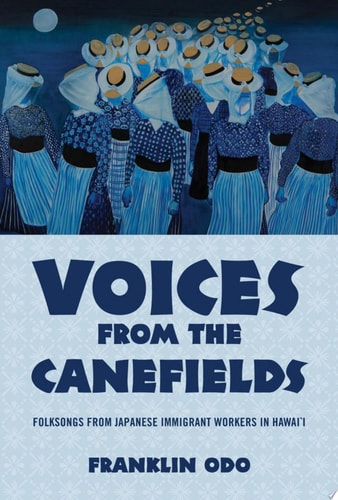
Voices from the Canefields: Folksongs from Japanese Immigrant Workers in Hawai'i
0
0
As an Amazon Associate and affiliate partner, Menrva Books earns from qualifying purchases. Learn more
Author Description
Folk songs are short stories from the souls of common people. Some, like Mexican corridos or Scottish ballads, reworked in the Appalachias, are stories of tragic or heroic episodes. Others, like the African American blues, reach from a difficult present back into slavery and forward into a troubled future. Japanese workers in Hawaii's plantations created their own versions, in form more akin to their traditional tanka or haiku poetry. These holehole bushi describe the experiences of one particular group caught in the global movements of capital, empire, and labor during the late nineteenth and early twentieth centuries. In Voices from the Canefields author Franklin Odo situates over two hundred of these songs, in translation, in a hitherto largely unexplored historical context.Japanese laborers quickly comprised the majority of Hawaiian sugar plantation workers after their large-scale importation as contract workers in 1885. Their folk songs provide good examples of the intersection between local work/life and the global connection which the workers clearly perceived after arriving. While many are songs of lamentation, others reflect a rapid adaptation to a new society in which other ethnic groups were arranged in untidy hierarchical order - the origins of a unique multicultural social order dominated by an oligarchy of white planters. Odo also recognizes the influence of the immigrants' rapidly modernizing homeland societies through his exploration of the "cultural baggage" brought by immigrants and some of their dangerous notions of cultural superiority. Japanese immigrants were thus simultaneously the targets of intense racial and class vitriol even as they took comfort in the expanding Japanese empire.Engagingly written and drawing on a multitude of sources including family histories, newspapers, oral histories, the expressed perspectives of women in this immigrant society, and accounts from the prolific Japanese language press into the narrative, Voices from the Canefields provides a unique window into the lives of these workers.
Menrva's Summary
THE THESIS
This work investigates the historical and cultural significance of holehole bushi, the folk songs created by Japanese immigrant laborers on Hawaiian sugar plantations during the late nineteenth and early twentieth centuries. Franklin Odo, a scholar of Asian American history, utilizes a vast array of primary sources to contextualize these songs within the broader frameworks of global capital, empire, and labor migration. By analyzing these lyrical expressions, Odo argues that the songs serve as vital records of the immigrants' adaptation to a complex, hierarchical multicultural society in Hawaii.
THE SCOPE MAP
What You Will Find
- A collection of over two hundred translated holehole bushi folk songs.
- An analysis of the intersection between local plantation labor conditions and global imperial movements.
- Historical evidence drawn from family records, oral histories, and the Japanese language press in Hawaii.
- An exploration of the cultural baggage and social dynamics among immigrant workers navigating racial and class hierarchies.
THE AUTHORITY PERSPECTIVE
Scholars and historians recognize this text as a significant contribution to the study of the Japanese diaspora and labor history in the Pacific. Readers frequently note the depth of the research and the author's success in elevating the voices of common laborers through their own lyrical traditions.
Page Count:
272
Publication Date:
2013-10-25
Publisher:
Oxford University Press
ISBN-10:
0199813035
ISBN-13:
9780199813032
History
Music
Sociology
Folklore
Music Hawaiian
Labor history
Immigrants
Community Tags
Other Editions(3)

Similar Books





Reader Comments
Share Your Thoughts
No comments yet. Be the first to share your thoughts!