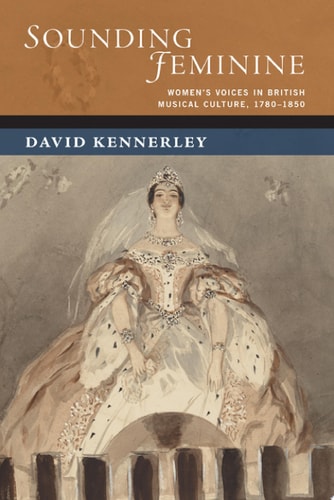
Sounding Feminine
0
0
As an Amazon Associate and affiliate partner, Menrva Books earns from qualifying purchases. Learn more
Author Description
Between 1780 And 1850, The Growing Prominence Of Female Singers In Britain's Professional And Amateur Spheres Opened A Fraught Discourse About Women's Engagement With Musical Culture. Protestant Evangelical Gender Ideology Framed The Powerful, Well-trained, And Expressive Female Voice As A Sign Of Inner Moral Corruption, While More Restrained And Delicate Vocal Styles Were Seen As Indicative Of The Performer's Virtuous Femininity. Yet Far From Everyone Was Of This Persuasion, And Those From Alternative Class And Religious Milieux Responded In More Affirmative Ways To The Sound Of Professional Female Voices. The Meanings Listeners Ascribed To Women's Voices Reflect Crucial Developments In The Musical World Of The Period, Such As The Popularity Of Particular Genres With Audiences Of Certain Social Backgrounds, And The Reasons Underpinning The Development Of Prevalent Types Of Nineteenth-century Professional Female Vocality. Sounding Feminine Traces The Development Of Attitudes Towards The Female Voice That Have Decisively Shaped Modern British Society And Culture. Arguing For The Importance Of The Aural Dimension Of The Past, Author David Kennerley Draws From A Variety Of Fields-including Sound Studies, Sensory Histories, And Gender Theory-to Examine How Audiences Heard Different Kinds Of Femininities In The Voices Of British Female Singers. Sounding Feminine Explores The Intense Divisions Over The Correct Use Of The Female Voice, And The Intricate Links Between Gender, Nationality, Class, And Religion In Ascribing Status, Purpose, And Morality To Female Singing. Through This Lens, Kennerley Also Explores The Formation Of British Middle-class Identities And The Cultural Impact Of The Evangelical Revival-deepening Our Understanding Of This Period Of Transformational Change In British Culture.
Menrva's Summary
THE THESIS
How did the emergence of professional female singers in Britain between 1780 and 1850 influence societal perceptions of gender, morality, and class identity? David Kennerley, a scholar of music and cultural history, utilizes a multidisciplinary framework to investigate the intersection of vocal performance and social ideology. By analyzing the tension between Protestant Evangelical moral codes and the rising popularity of female vocalists, the book argues that the aural reception of these voices was a primary site for negotiating British middle-class identity and cultural values.
THE SCOPE MAP
What You Will Find
- Analysis of the impact of the Evangelical Revival on musical performance standards.
- Examination of the link between vocal style and perceived feminine virtue.
- Integration of sound studies, sensory history, and gender theory methodologies.
- Historical survey of British professional and amateur musical spheres from 1780 to 1850.
Scope Limits
- The study is geographically restricted to the British context.
- The analysis focuses primarily on the period between 1780 and 1850, excluding later developments in vocal pedagogy.
THE AUTHORITY PERSPECTIVE
Scholars in the fields of musicology and gender history recognize this work as a significant contribution to the study of sensory history and the cultural politics of the voice. Readers frequently note the academic density of the prose, which provides a rigorous examination of how historical audiences constructed meaning through sound.
Page Count:
224
Publication Date:
2020-01-01
Publisher:
Oxford University Press
ISBN-10:
0190097574
ISBN-13:
9780190097578
Cultural History
Sound Studies
Gender Studies
British History
Music History
Community Tags
Similar Books



![The Remoter rural areas of Britain: [a symposium held at the University of Newcastle upon Tyne, 1970];](https://storage.googleapis.com/menrva_img_storage/covers/9780050024713.jpg)