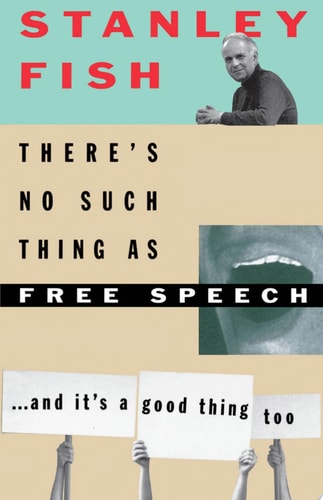
There's No Such Thing as Free Speech: And It's a Good Thing, Too
0
0
As an Amazon Associate and affiliate partner, Menrva Books earns from qualifying purchases. Learn more
Author Description
In an era when much of what passes for debate is merely moral posturing--traditional family values versus the cultural elite, free speech versus censorship--or reflexive name-calling--the terms "liberal" and "politically correct," are used with as much dismissive scorn by the right as "reactionary" and "fascist" are by the left--Stanley Fish would seem an unlikely lightning rod for controversy. A renowned scholar of Milton, head of the English Department of Duke University, Fish has emerged as a brilliantly original critic of the culture at large, praised and pilloried as a vigorous debunker of the pieties of both the left and right. His mission is not to win the cultural wars that preoccupy the nation's attention, but rather to redefine the terms of battle. In There's No Such Thing as Free Speech, Fish takes aim at the ideological gridlock paralyzing academic and political exchange in the nineties. In his witty, accessible dissections of the swirling controversies over multiculturalism, affirmative action, canon revision, hate speech, and legal reform, he neatly eviscerates both the conservatives' claim to possession of timeless, transcendent values (the timeless transcendence of which they themselves have conveniently identified), and the intellectual left's icons of equality, tolerance, and non-discrimination. He argues that while conservative ideologues and liberal stalwarts might disagree vehemently on what is essential to a culture, or to a curriculum, both mistakenly believe that what is essential can be identified apart from the accidental circumstances (of time and history) to which the essential is ritually opposed. In the book's first section, which includes the five essays written for Fish's celebrated debates with Dinesh D'Souza (the author and former Reagan White House policy analyst), Fish turns his attention to the neoconservative backlash. In his introduction, Fish writes, "Terms that come to us wearing the label 'apolitical'--'common values', 'fair
Menrva's Summary
THE THESIS
This work investigates the premise that the concept of free speech is not an absolute, transcendent principle but rather a construct contingent upon specific historical and political circumstances. Stanley Fish, a prominent scholar of literature and law, utilizes his background in critical theory to dismantle the ideological rigidity found in both conservative and liberal discourse. He argues that political debates are often paralyzed by the false belief that values can be identified independently of the social and historical contexts in which they are embedded.
THE SCOPE MAP
What You Will Find
- Analysis of ideological gridlock surrounding multiculturalism and affirmative action.
- Critiques of the rhetoric used in debates over hate speech and legal reform.
- Examination of the neoconservative backlash through a series of essays and debates.
- A deconstruction of the binary opposition between essentialist values and historical contingency.
THE AUTHORITY PERSPECTIVE
Critics and scholars often note the provocative nature of Fish's prose, which challenges foundational assumptions in legal and academic circles. Readers frequently highlight the text's utility in understanding the rhetorical mechanisms that sustain contemporary political polarization.
Page Count:
344
Publication Date:
1994-01-01
Publisher:
Oxford University Press
ISBN-10:
019983928X
ISBN-13:
9780199839285
Philosophy
Freedom of speech
Sociology
English
Professional Career & Trade
Law
English & College Success
Community Tags
Other Editions(2)
Similar Books




Reader Comments
Share Your Thoughts
No comments yet. Be the first to share your thoughts!