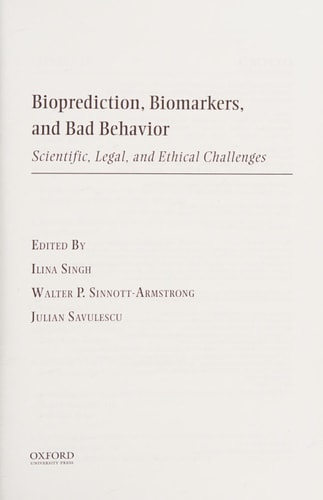
Bioprediction, Biomarkers, and Bad Behavior: Scientific, Legal, and Ethical Challenges
0
0
As an Amazon Associate and affiliate partner, Menrva Books earns from qualifying purchases. Learn more
Author Description
Many decisions in the legal system and elsewhere depend on predictions of bad behaviors, including crimes and mental illnesses. Some scientists have suggested recently that these predictions can become more accurate and useful if they are based in part on biological information, such as brain structure and function, genes, and hormones. The prospect of such bioprediction, however, raises serious concerns about errors and injustice. Can biological information significantly increase the accuracy of predictions of bad behavior? Will innocent or harmless people be mistakenly treated as if they were guilty or dangerous? Is it fair to keep people in prisons or mental institutions longer because of their biology? Will these new instruments of bioprediction be abused in practice within current institutions? Is bioprediction worth the cost? Do we want our government to use biology in this way? All of these scientific, legal, and ethical questions are discussed in this volume. The contributors are prominent neuroscientists, psychologists, sociologists, philosophers, ethicists, and legal scholars. This volume will interest everyone with hopes that bioprediction will solve problems or fears that bioprediction will be applied unjustly.
Menrva's Summary
THE THESIS
This volume investigates whether the integration of biological data—such as genetics, brain imaging, and hormonal markers—into legal and institutional decision-making processes improves the accuracy of behavioral predictions or introduces systemic ethical and social risks. The authors, a multidisciplinary team of neuroscientists, legal scholars, and philosophers, examine the intersection of predictive science and justice. They provide a framework for evaluating the validity of bioprediction while addressing the potential for institutional abuse and the erosion of individual rights. By synthesizing empirical data with normative ethical analysis, the text challenges the assumption that biological markers provide an objective basis for determining future dangerousness or criminal culpability.
THE SCOPE MAP
What You Will Find
- Analysis of neuroscientific data including brain structure, genetic markers, and hormonal influences on behavior.
- Legal and ethical frameworks for assessing the fairness of using biological evidence in sentencing and institutionalization.
- Case studies and theoretical arguments regarding the potential for bias and error in predictive modeling.
- Multidisciplinary perspectives from psychology, sociology, and philosophy on the societal implications of biological determinism.
THE AUTHORITY PERSPECTIVE
Experts identify this volume as a foundational text for those navigating the complex intersection of neuro-law and bioethics. Readers frequently note the academic density of the prose, which serves as a comprehensive resource for scholars and practitioners evaluating the future of forensic science and public policy.
Page Count:
264
Publication Date:
2013-10-18
Publisher:
Oxford University Press
ISBN-10:
0199844186
ISBN-13:
9780199844180
Psychology
Science
Philosophy
Mental Illness
Neuroscience
Law
Sociology
Ethics
Community Tags
Similar Books