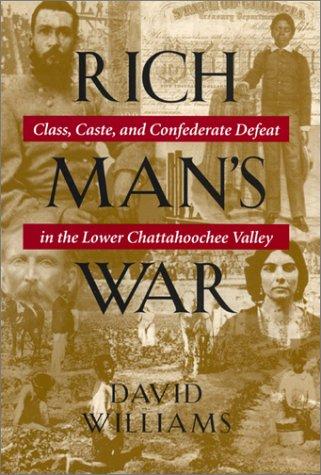
Rich Man's War
0
0
As an Amazon Associate and affiliate partner, Menrva Books earns from qualifying purchases. Learn more
Author Description
In Rich Man's War historian David Williams focuses on the Civil War experience of people in the Chattahoochee Valley of Georgia and Alabama to illustrate how the exploitation of enslaved blacks and poor whites by a planter oligarchy generated overwhelming class conflict across the South, eventually leading to Confederate defeat. This conflict was clearly highlighted by the perception that the Civil War was "a rich man's war and a poor man's fight.". Throughout the war growing numbers of oppressed whites and blacks openly rebelled against Confederate authority, undermining the fight for independence. Southern plain folk expressed an increasingly antagonistic attitude toward the region's elite and the Confederacy itself as the war dragged on, and slaves looked forward to the Confederacy's downfall and the freedom they hoped it would bring. After the war, however, the upper classes were able to prevent a class revolution by encouraging enmity between freedpeople and poor whites. Trapped by racism and poverty, the poor remained in virtual economic slavery, dominated by an almost unchanged planter elite. Nowhere was the impact of class and caste on Confederate defeat more evident than in the lower Chattahoochee Valley.
Menrva's Summary
THE THESIS
The Civil War was perceived as a conflict fought by the poor for the benefit of the rich, a sentiment that fueled class conflict across the South and ultimately contributed to Confederate defeat. Historian David B. Williams examines the Chattahoochee Valley of Georgia and Alabama to demonstrate how the exploitation of enslaved people and poor whites by a planter elite generated deep-seated class divisions. As the war progressed, oppressed whites and blacks increasingly rebelled against Confederate authority, undermining the war effort and fostering animosity toward the ruling class. The narrative framework is historical analysis, drawing on evidence of open rebellion and shifting attitudes among the populace.
THE SCOPE MAP
- Focuses on the Civil War experience in the Chattahoochee Valley of Georgia and Alabama.
- Illustrates how class conflict, driven by the exploitation of enslaved blacks and poor whites, impacted the Confederacy.
- Highlights the perception of the Civil War as 'a rich man's war and a poor man's fight'.
- Details open rebellion against Confederate authority by oppressed whites and blacks.
- Examines the growing antagonism of Southern plain folk toward the elite and the Confederacy.
- Discusses slaves' anticipation of Confederate downfall and their hope for freedom.
- Analyzes how the upper classes prevented post-war class revolution by fostering enmity between freedpeople and poor whites.
- Demonstrates the impact of class and caste on Confederate defeat in the lower Chattahoochee Valley.
THE AUTHORITY PERSPECTIVE
The book examines the internal class conflicts within the Confederacy, particularly in the Chattahoochee Valley, arguing that these divisions significantly weakened the Confederate cause. It highlights the growing dissent among poor whites and enslaved people against the planter elite and their war aims. The analysis suggests that the Confederacy's defeat was not solely due to external pressures but also internal social and economic fractures. Post-war dynamics are also explored, showing how the elite maintained control by manipulating racial and class tensions.
Page Count:
288
Publication Date:
1998-01-01
ISBN-10:
0820320331
ISBN-13:
9780820320335
Non-Fiction
History
American History
Class Conflict
Social History
Slavery
Civil War
Community Tags
Similar Books














