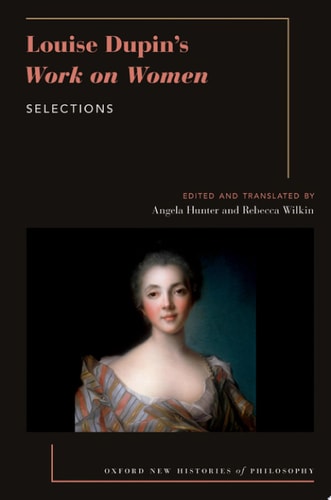
Louise Dupin's Work on Women: Selections
0
0
As an Amazon Associate and affiliate partner, Menrva Books earns from qualifying purchases. Learn more
Author Description
The eighteenth-century text Work on Women by Louise Dupin (also known as Madame Dupin, 1706-1799) is the French Enlightenment's most in-depth feminist analysis of inequality--and its most neglected one. Angela Hunter and Rebecca Wilkin here offer the first-ever edition of selected translations of Dupin's massive project, developed from manuscript drafts. Hunter and Wilkin provide helpful introductions to the four sections of Work on Women (Science, History and Religion, Law, and Education and Mores) which contextualize Dupin's arguments and explain the work's construction--including the role of her secretary, Jean-Jacques Rousseau.Dupin's central claim in Work on Women is that French jurists have gradually disenfranchised women through reductive interpretations of Roman law. As a result, modern marriage is founded on an abusive, illegitimate contract that enriches one party and impoverishes the other. This manifest injustice is enabled by the "masculine vanity" that aggrandizes men, diminishes women, and distorts all realms of knowledge. Dupin shows how the most reputable scientists incorporate old notions of women's weakness into new understandings of the body, while historians denigrate female rulers or erase them altogether. Even in everyday conversation, men assert their entitlement to social dominance through casual misogyny. Thus, although Dupin advocates for meaningful education for girls, she insists that the upbringing of boys must also be reformed.This volume fills an important gap in the history of feminist thought and will appeal to readers eager to hear new voices that challenge established narratives of intellectual history.
Menrva's Summary
THE THESIS
This volume investigates the core question of how eighteenth-century legal and social structures systematically disenfranchised women through the lens of Louise Dupin's neglected manuscript, Work on Women. Angela Hunter and Rebecca Wilkin, both scholars of French literature and philosophy, curate these selections to demonstrate how Dupin challenged the intellectual foundations of her era. By analyzing Dupin's critique of Roman law and Enlightenment-era gender biases, the authors provide a framework for understanding the historical roots of modern gender inequality.
THE SCOPE MAP
What You Will Find
- Analysis of the four primary sections of Dupin's work: Science, History and Religion, Law, and Education and Mores.
- Contextualization of the collaboration between Louise Dupin and her secretary, Jean-Jacques Rousseau.
- Examination of how masculine vanity influenced Enlightenment-era scientific and historical discourse.
Scope Limits
- The text focuses specifically on the provided selections from Dupin's massive, multi-volume manuscript project.
- It does not provide a comprehensive biography of Louise Dupin beyond her intellectual contributions to this specific work.
THE AUTHORITY PERSPECTIVE
Scholars and historians identify this volume as a significant contribution to the recovery of marginalized voices within the French Enlightenment. Readers frequently note that the editors provide necessary clarity to the complex, multi-layered arguments presented in Dupin's original manuscript.
Page Count:
318
Publication Date:
2023-07-21
Publisher:
Oxford University Press
ISBN-10:
019009009X
ISBN-13:
9780190090098
History
Philosophy
Gender Studies
Feminist Theory
Community Tags
Similar Books