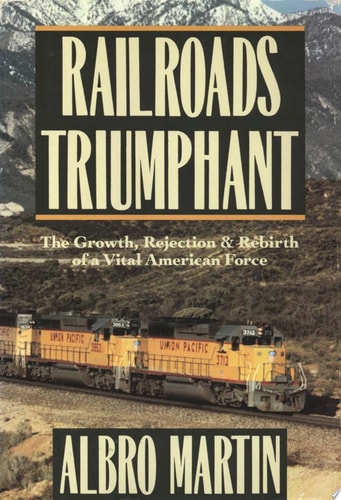
Railroads Triumphant: The Growth, Rejection, and Rebirth of a Vital American Force
0
0
As an Amazon Associate and affiliate partner, Menrva Books earns from qualifying purchases. Learn more
Author Description
In 1789, when the First Congress met in New York City, the members traveled to the capital just as Roman senators two thousand years earlier had journeyed to Rome, by horse, at a pace of some five miles an hour. Indeed, if sea travel had improved dramatically since Caesar's time, overland travel was still so slow, painful, and expensive that most Americans lived all but rooted to the spot, with few people settling more than a hundred miles from the ocean (a mere two percent lived west of the Appalachians). America in effect was just a thin ribbon of land by the sea, and it wasn't until the coming of the steam railroad that our nation would unfurl across the vast inland territory. In Railroads Triumphant, Albro Martin provides a fascinating history of rail transportation in America, moving well beyond the "Romance of the Rails" sort of narrative to give readers a real sense of the railroad's importance to our country. The railroad, Martin argues, was "the most fundamental innovation in American material life." It could go wherever rails could be laid--and so, for the first time, farms, industries, and towns could leave natural waterways behind and locate anywhere. (As Martin points out, the railroads created small-town America just as surely as the automobile created the suburbs.) The railroad was our first major industry, and it made possible or promoted the growth of all other industries, among them coal, steel, flour milling, and commercial farming. It established such major cities as Chicago, and had a lasting impact on urban design. And it worked hand in hand with the telegraph industry to transform communication. Indeed, the railroads were the NASA of the 19th century, attracting the finest minds in finance, engineering, and law. But Martin doesn't merely catalogue the past greatness of the railroad. In closing with the episodes that led first to destructive government regulation, and then to deregulation of the railroads and the ensuing triumphant rebirth of the industry, he provides a complete picture of this vital American force.
Menrva's Summary
THE THESIS
The central thesis of this work is that the steam railroad served as the most fundamental innovation in American material life, acting as the primary catalyst for the nation's geographic and industrial expansion. Albro Martin, a respected historian of American business, utilizes extensive economic and industrial data to argue that the railroad was the essential infrastructure that allowed the United States to transcend its coastal limitations. He frames the railroad not merely as a mode of transport, but as the 19th-century equivalent of a modern technological powerhouse, attracting the era's most significant financial and engineering talent.
THE SCOPE MAP
What You Will Find
- A comprehensive history of American rail development from the early 19th century through the era of deregulation.
- Analysis of the railroad's role in the growth of secondary industries like coal, steel, and commercial farming.
- Examination of the symbiotic relationship between rail expansion and the development of the telegraph.
- Case studies on the creation of urban centers and the transformation of small-town American geography.
THE AUTHORITY PERSPECTIVE
Historians and economists frequently cite this text as a definitive account of the railroad's structural impact on the American economy. Scholars often highlight the author's ability to balance technical industrial history with a broader narrative regarding the nation's development.
Page Count:
443
Publication Date:
1992-01-01
Publisher:
Oxford University Press
ISBN-10:
0199878633
ISBN-13:
9780199878635
Economics
History
Transportation
Railroads
Economics history
Technology
United States
History of the Americas
Railroads history
American History
Community Tags
Similar Books






Reader Comments
Share Your Thoughts
No comments yet. Be the first to share your thoughts!