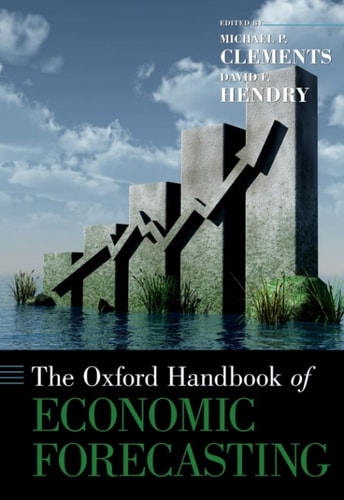
The Oxford Handbook of Economic Forecasting
0
0
As an Amazon Associate and affiliate partner, Menrva Books earns from qualifying purchases. Learn more
Author Description
This Handbook provides up-to-date coverage of both new and well-established fields in the sphere of economic forecasting. The chapters are written by world experts in their respective fields, and provide authoritative yet accessible accounts of the key concepts, subject matter, and techniques in a number of diverse but related areas. It covers the ways in which the availability of ever more plentiful data and computational power have been used in forecasting, in terms of the frequency of observations, the number of variables, and the use of multiple data vintages. Greater data availability has been coupled with developments in statistical theory and economic analysis to allow more elaborate and complicated models to be entertained; the volume provides explanations and critiques of these developments. These include factor models, DSGE models, restricted vector autoregressions, and non-linear models, as well as models for handling data observed at mixed frequencies, high-frequency data, multiple data vintages, methods for forecasting when there are structural breaks, and how breaks might be forecast. Also covered are areas which are less commonly associated with economic forecasting, such as climate change, health economics, long-horizon growth forecasting, and political elections. Econometric forecasting has important contributions to make in these areas along with how their developments inform the mainstream.
Menrva's Summary
THE THESIS
This volume investigates the current state and future trajectory of economic forecasting by synthesizing advancements in statistical theory, computational power, and data availability. Edited by David F. Hendry and Michael P. Clements, the text gathers contributions from leading experts to evaluate how modern econometric models address complex variables and structural shifts. The authors provide a rigorous framework for understanding both traditional forecasting methods and emerging techniques applied to diverse global challenges.
THE SCOPE MAP
What You Will Find
- Advanced modeling techniques including factor models, DSGE models, and restricted vector autoregressions.
- Methodologies for managing high-frequency data, mixed-frequency observations, and multiple data vintages.
- Analytical approaches for forecasting in the presence of structural breaks and long-horizon growth patterns.
- Cross-disciplinary applications in climate change, health economics, and political election forecasting.
THE AUTHORITY PERSPECTIVE
Experts recognize this volume as a comprehensive reference for researchers and practitioners navigating the intersection of data science and economic theory. Readers frequently note the technical density of the prose, which serves as a foundational resource for advanced study in econometrics.
Page Count:
712
Publication Date:
2011-01-01
Publisher:
Oxford University Press
ISBN-10:
0199875510
ISBN-13:
9780199875511
Economics
Statistics
Principles of Microeconomics
Finance
Reference
Econometrics
Community Tags
Other Editions(3)
Similar Books