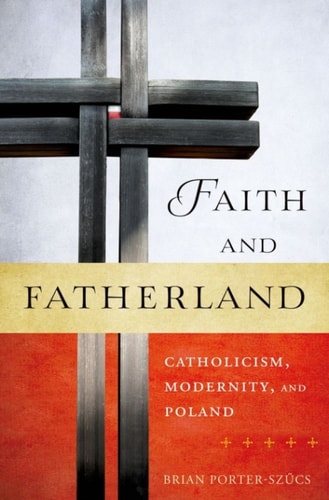
Faith and Fatherland: Catholicism, Modernity, and Poland
0
0
As an Amazon Associate and affiliate partner, Menrva Books earns from qualifying purchases. Learn more
Author Description
Jesus instructed his followers to "love your enemies, do good to those who hate you, bless those who curse you, pray for those who mistreat you" (Luke 6:27-28). Not only has this theme long been among the Church's most oft-repeated messages, but in everything from sermons to articles in the Catholic press, it has been consistently emphasized that the commandment extends to all humanity. Yet, on numerous occasions in the twentieth century, Catholics have established alliances with nationalist groups promoting ethnic exclusivity, anti-Semitism, and the use of any means necessary in an imagined "struggle for survival." While some might describe this as mere hypocrisy, Faith and Fatherland analyzes how Catholicism and nationalism have been blended together in Poland, from Nazi occupation and Communist rule to the election of Pope John Paul II and beyond. It is usually taken for granted that Poland is a Catholic nation, but in fact the country's apparent homogeneity is a relatively recent development, supported as much by ideology as demography. To fully contextualize the fusion between faith and fatherland, Brian Porter-Szucs examines concepts like sin, the Church, the nation, and the Virgin Mary-ultimately showing how these ideas were assembled to create a powerful but hotly contested form of religious nationalism. By no means was this outcome inevitable, and it certainly did not constitute the only way of being Catholic in modern Poland. Nonetheless, the Church's ongoing struggle to find a place within an increasingly secular European modernity made this ideological formation possible and gave many Poles a vocabulary for social criticism that helped make sense of grievances and injustices.
Menrva's Summary
THE THESIS
This book investigates the historical development of religious nationalism in Poland, specifically examining how Catholic identity and nationalist ideology became fused throughout the twentieth century. Brian Porter-Szucs, a scholar of Polish history, utilizes a wide array of primary sources, including church documents, press archives, and political literature, to deconstruct the narrative of Poland as an inherently Catholic nation. He argues that this fusion was not an inevitable outcome of faith, but rather a constructed ideological response to the pressures of modernity, secularization, and political upheaval under Nazi and Communist regimes.
THE SCOPE MAP
What You Will Find
- Historical analysis of the intersection between Polish Catholicism and nationalist movements from the mid-twentieth century to the post-Communist era.
- Examination of key conceptual frameworks including the role of the Church, the Virgin Mary, and the definition of sin in political discourse.
- Use of primary source materials such as Catholic press articles, sermons, and political manifestos to track ideological shifts.
- Investigation into how religious vocabulary provided a framework for Poles to articulate social grievances and navigate political injustices.
THE AUTHORITY PERSPECTIVE
Scholars and historians frequently cite this work as a critical intervention in the study of religious nationalism, noting its ability to challenge simplistic assumptions about Polish homogeneity. The text is recognized for its rigorous archival research and its nuanced approach to the complex relationship between institutional religion and modern statecraft.
Page Count:
496
Publication Date:
2011-01-01
Publisher:
Oxford University Press
ISBN-10:
0199875537
ISBN-13:
9780199875535
History
Religion
Catholic Church
European History
Nationalism
Catholicism
Poland
Community Tags
Similar Books