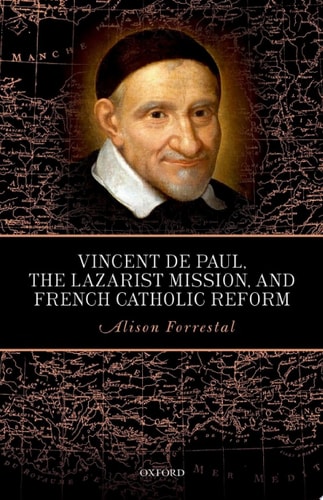
Vincent de Paul, the Lazarist Mission, and French Catholic Reform
0
0
As an Amazon Associate and affiliate partner, Menrva Books earns from qualifying purchases. Learn more
Author Description
Vincent de Paul, the Lazarist Mission, and French Catholic Reform offers a major re-assessment of the thought and activities of the most famous figure of the seventeenth-century French Catholic Reformation, Vincent de Paul. Confronting traditional explanations for de Paul's prominence in the dévot reform movement that emerged in the wake of the Wars of Religion, the volume explores how he turned a personal vocational desire to evangelize the rural poor of France into a congregation of secular missionaries, known as the Congregation of the Mission or the Lazarists, with three inter-related strands of pastoral responsibility: the delivery of missions, the formation and training of clergy, and the promotion of confraternal welfare. Alison Forrestal further demonstrates that the structure, ethos, and works that de Paul devised for the Congregation placed it at the heart of a significant enterprise of reform that involved a broad set of associates in efforts to transform the character of devotional belief and practice within the church. The central questions of the volume therefore concern de Paul's efforts to create, characterize, and articulate a distinctive and influential vision for missionary life and work, both for himself and for the Lazarist Congregation, and Forrestal argues that his prominence and achievements depended on his remarkable ability to exploit the potential for association and collaboration within the dévot environment of seventeenth-century France in enterprising and systematic ways. This is the first study to assess de Paul's activities against the wider backdrop of religious reform and Bourbon rule, and to reconstruct the combination of ideas, practices, resources, and relationships that determined his ability to pursue his ambitions. A work of forensic detail and complex narrative, Vincent de Paul, the Lazarist Mission, and French Catholic Reform is the product of years of research in ecclesiastical and state archives. It offers a wholly fresh p
Menrva's Summary
THE THESIS
This volume investigates how Vincent de Paul transformed a personal vocational desire into the Congregation of the Mission, thereby shaping the trajectory of seventeenth-century French Catholic reform. Alison Forrestal, a scholar of early modern religious history, utilizes extensive archival research to challenge traditional hagiographical interpretations of de Paul. She argues that his influence was not merely a product of individual piety but a result of his systematic ability to leverage collaborative networks and institutional structures within the dévot movement.
THE SCOPE MAP
What You Will Find
- Analysis of the Congregation of the Mission's three core pillars: rural missions, clergy training, and confraternal welfare.
- Examination of the intersection between religious reform and Bourbon state politics.
- Detailed reconstruction of the social and institutional relationships that facilitated de Paul's missionary ambitions.
Scope Limits
- The study focuses primarily on the institutional and structural development of the Lazarists rather than a comprehensive biography of de Paul's private spiritual life.
THE AUTHORITY PERSPECTIVE
Scholars recognize this work as a significant contribution to the study of early modern ecclesiastical history due to its rigorous archival foundation. Readers frequently note the academic density of the prose, which provides a precise, evidence-based assessment of de Paul's role within the broader context of French religious reform.
Page Count:
321
Publication Date:
2017-01-01
Publisher:
OUP Oxford
ISBN-10:
0191088749
ISBN-13:
9780191088742
Biography
History
Religion
Catholic Church
Seventeenth Century
Catholicism
Ecclesiastical History
European History
Community Tags
Other Editions(2)

Similar Books









Reader Comments
Share Your Thoughts
No comments yet. Be the first to share your thoughts!