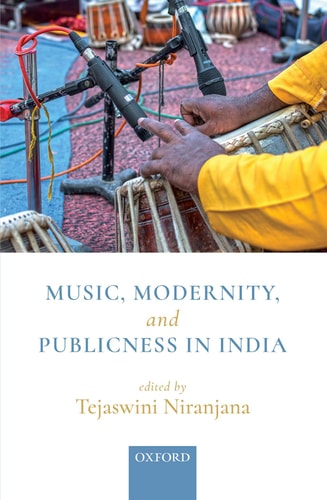
Music, Modernity, and Publicness in India
0
0
As an Amazon Associate and affiliate partner, Menrva Books earns from qualifying purchases. Learn more
Author Description
A collection of essays that focus on the role of music in the formation of a public in India across the twentieth century, Music, Modernity, and Publicness in India looks at different regions, languages, and different genres and styles of music.Modernity fundamentally changed the relationship between private and public realms. New social arrangements gave rise to new forms of music making, with the musicians no longer performing exclusively in the princely courts or in the private homes of the wealthy. Not only did the act of listening to, and appreciating music became an important feature of public life in modern times, it also influenced how modernity itself took shape. Music became a key site for the articulation of questions of the public and of politics, and the essays in this volume look at various such aspects, from the formation of modern spaces of performance, certain forms of music assuming the status of classic, creation of a national and nationalistic tradition, and circulation of music in popular politics to broadcast technology. Through exploring these diverse inter-disciplinary questions relating to music, musicians, and their audiences, the volume provides new entry-points for the discussion of music and modern-day cultural practice in India.
Menrva's Summary
THE THESIS
This collection of essays investigates how music served as a primary catalyst and site for the construction of public life and modern identity in twentieth-century India. Tejaswini Niranjana, a scholar of cultural studies, compiles interdisciplinary research to examine the shift of musical performance from private princely courts to the broader public sphere. The volume argues that the evolution of musical consumption and production was not merely a reflection of social change but an active participant in shaping the political and nationalistic landscape of modern India.
THE SCOPE MAP
What You Will Find
- Analysis of the transition of musical performance spaces from elite courts to public venues
- Examination of how broadcast technology influenced musical circulation and national identity
- Exploration of the canonization of specific musical genres as classical traditions
- Case studies across diverse Indian regions, languages, and musical styles
Scope Limits
- The text does not provide a comprehensive history of all Indian musical traditions
- It does not focus on technical music theory or the mechanics of composition
THE AUTHORITY PERSPECTIVE
Scholars in the field of ethnomusicology and South Asian studies recognize this volume as a significant contribution to the understanding of cultural modernity. Readers frequently note the academic density of the prose and the interdisciplinary approach used to bridge the gap between musicology and political sociology.
Page Count:
288
Publication Date:
2020-08-04
Publisher:
Oxford University Press
ISBN-10:
0190121122
ISBN-13:
9780190121129
Sociology
Criticism history
Indian History
Modernity
Musicology
Community Tags
Similar Books