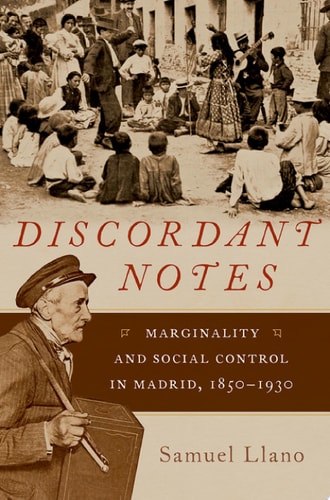
Discordant Notes: Marginality and Social Control in Madrid, 1850-1930
0
0
As an Amazon Associate and affiliate partner, Menrva Books earns from qualifying purchases. Learn more
Author Description
Scholarship on urban culture and the senses has traditionally focused on the study of literature and the visual arts. Recent decades have seen a surge of interest on the effects of sound the urban space and its population. These studies analyse how sound generates identities that are often fragmentary and mutually conflicting. They also explore the ways in which sound triggers campaigns against the negative effects of noise on the nerves and health of the population. Little research has been carried out about the impact of sound and music in areas of broader social and political concern such as social aid, hygiene and social control. Based on a detailed study of Madrid from the 1850s to the 1930s, Discordant Notes argues that sound and music have played a key role in structuring the transition to modernity by helping to negotiate social attitudes and legal responses to problems such as poverty, insalubrity, and crime. Attempts to control the social groups that own unwanted musical practices such as organ grinding and flamenco performances in taverns raised awareness about public hygiene, alcoholism and crime, and triggered legal reform in these areas. In addition to scapegoating, marginalising and persecuting these musical practices, the authorities and the media used workhouse bands as instruments of social control to spread "aural hygiene" across the city.
Menrva's Summary
THE THESIS
How did the regulation of sound and music in 19th and early 20th-century Madrid serve as a mechanism for social control and the management of urban modernity? Samuel Llano, a scholar of music and urban culture, utilizes archival research and historical analysis to demonstrate that sound was not merely an aesthetic element but a political tool. The book argues that authorities and media outlets leveraged concerns over noise, hygiene, and morality to marginalize specific social groups and implement legal reforms regarding poverty and crime.
THE SCOPE MAP
What You Will Find
- Historical analysis of Madrid from 1850 to 1930
- Examination of the intersection between musicology, urban planning, and social policy
- Case studies on the regulation of organ grinding and flamenco performances
- Investigation into the use of workhouse bands as tools for moral and social discipline
Scope Limits
- The study is geographically restricted to Madrid and does not provide a comprehensive analysis of other Spanish cities or international urban centers.
THE AUTHORITY PERSPECTIVE
Experts in Iberian studies and musicology recognize this work as a significant contribution to the field of sound studies, particularly for its focus on the intersection of auditory culture and social governance. Readers frequently note the academic density of the prose, which provides a rigorous framework for understanding how soundscapes influence urban policy.
Page Count:
272
Publication Date:
2018-01-01
Publisher:
Oxford University Press
ISBN-10:
0190916362
ISBN-13:
9780190916367
History
Music
Criticism history
Musicology
Social History
Ethnic
Music History
Urban Studies
Music Spanish
Humanities
Spain
Community Tags
Other Editions(2)
Similar Books