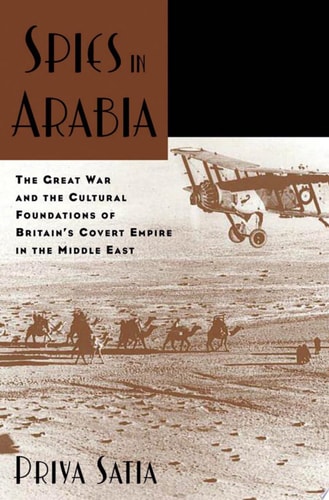
Spies in Arabia: The Great War and the Cultural Foundations of Britain's Covert Empire in the Middle East
0
0
As an Amazon Associate and affiliate partner, Menrva Books earns from qualifying purchases. Learn more
Author Description
At the dawn of the twentieth century, British intelligence agents began to venture in increasing numbers to the Arab lands of the Ottoman Empire, a region of crucial geopolitical importance spanning present-day Iraq, Jordan, Syria, and Saudi Arabia. They were drawn by the twin objectives of securing the land route to India and finding adventure and spiritualism in a mysterious and ancient land. But these competing desires created a dilemma: how were they to discreetly and patriotically gather facts in a region they were drawn to for its legendary inscrutability and by the promise of fame and escape from Britain? In this groundbreaking book, Priya Satia tracks the intelligence community's tactical grappling with this problem and the myriad cultural, institutional, and political consequences of their methodological choices during and after the Great War. She tells the story of how an imperial state in thrall to the cultural notions of equivocal agents and beset by an equally captivated and increasingly assertive mass democracy invented a wholly new style of "covert empire" centered on the world's first brutal aerial surveillance regime in Iraq. Drawing on a wealth of archival sources--from the fictional to the recently declassified--this book explains how Britons reconciled genuine ethical scruples with the actual violence of their Middle Eastern empire. As it vividly demonstrates how imperialism was made fit for an increasingly democratic and anti-imperial world, what emerges is a new interpretation of the military, cultural, and political legacies of the Great War and of the British Empire in the twentieth century. Unpacking the romantic fascination with "Arabia" as the land of espionage, Spies in Arabia presents a stark tale of poetic ambition, war, terror, and failed redemption--and the prehistory of our present discontents.
Menrva's Summary
THE THESIS
How did British intelligence agents reconcile their romanticized perceptions of the Middle East with the brutal realities of maintaining a covert empire during and after the Great War? Priya Satia, a historian of the British Empire, utilizes a vast array of archival materials—including personal correspondence, official government records, and contemporary literature—to examine the intersection of cultural imagination and imperial policy. She argues that the British intelligence community developed a unique, surveillance-based style of governance in Iraq that allowed the state to project power while navigating the constraints of an increasingly democratic and anti-imperial domestic public. By analyzing the psychological and institutional motivations of these agents, Satia reveals how the pursuit of adventure and spiritualism fundamentally shaped the violent mechanisms of twentieth-century British colonial rule.
THE SCOPE MAP
What You Will Find
- Analysis of the British intelligence apparatus operating within the Ottoman Empire and its successor mandates.
- Examination of the transition from traditional colonial administration to modern aerial surveillance regimes in Iraq.
- Integration of literary and fictional sources alongside declassified government documents to map the cultural psyche of imperial agents.
- Investigation into the ethical contradictions faced by British officials as they balanced personal romanticism with the practical requirements of state violence.
THE AUTHORITY PERSPECTIVE
Scholars and historians frequently cite this work as a significant contribution to the study of imperial culture and the intellectual history of intelligence operations. Readers often note the dense, analytical nature of the prose, which provides a rigorous examination of how colonial narratives continue to influence contemporary geopolitical frameworks.
Page Count:
472
Publication Date:
2008-01-01
Publisher:
Oxford University Press
ISBN-10:
0199887101
ISBN-13:
9780199887101
History
Espionage British
Imperialism
Middle East
Military History
Great Britain
European History
Intelligence
Community Tags
Other Editions(2)

Similar Books









Reader Comments
Share Your Thoughts
No comments yet. Be the first to share your thoughts!