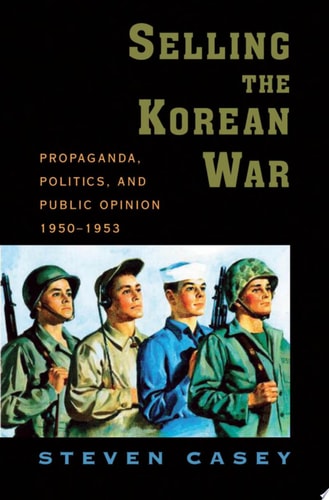
Selling the Korean War: Propaganda, Politics, and Public Opinion in the United States, 1950-1953
0
0
As an Amazon Associate and affiliate partner, Menrva Books earns from qualifying purchases. Learn more
Author Description
How presidents spark and sustain support for wars remains an enduring and significant problem. Korea was the first limited war the U.S. experienced in the contemporary period - the first recent war fought for something less than total victory. In Selling the Korean War, Steven Casey explores how President Truman and then Eisenhower tried to sell it to the American public.Based on a massive array of primary sources, Casey subtly explores the government's selling activities from all angles. He looks at the halting and sometimes chaotic efforts of Harry Truman and Dean Acheson, Dwight Eisenhower and John Foster Dulles. He examines the relationships that they and their subordinates developed with a host of other institutions, from Congress and the press to Hollywood and labor. And he assesses the complex and fraught interactions between the military and war correspondents in the battlefield theater itself.From high politics to bitter media spats, Casey guides the reader through the domestic debates of this messy, costly war. He highlights the actions and calculations of colorful figures, including Senators Robert Taft and Joseph McCarthy, and General Douglas MacArthur. He details how the culture and work routines of Congress and the media influenced political tactics and daily news stories. And he explores how different phases of the war threw up different problems - from the initial disasters in the summer of 1950 to the giddy prospects of victory in October 1950, from the massive defeats in the wake of China's massive intervention to the lengthy period of stalemate fighting in 1952 and 1953.
Menrva's Summary
THE THESIS
This book investigates the mechanisms by which the Truman and Eisenhower administrations attempted to cultivate and maintain public support for the Korean War, the first limited conflict of the modern era. Steven Casey, a historian specializing in international relations, utilizes an extensive collection of primary sources to analyze the intersection of executive strategy, media relations, and domestic political pressure. The work argues that the government's ability to manage public opinion was constrained by the unique challenges of a war fought for objectives short of total victory.
THE SCOPE MAP
What You Will Find
- Analysis of executive communication strategies during the Truman and Eisenhower presidencies.
- Examination of the institutional relationships between the White House, Congress, the press, and Hollywood.
- Case studies of battlefield reporting and the friction between military command and war correspondents.
- A chronological breakdown of public opinion shifts from the initial 1950 disasters to the 1953 stalemate.
THE AUTHORITY PERSPECTIVE
Experts recognize this work as a definitive account of the domestic political landscape during the Korean War. Scholars frequently cite the text for its meticulous use of archival data and its balanced assessment of how political culture shapes wartime communication.
Page Count:
488
Publication Date:
2008-01-01
Publisher:
Oxford University Press
ISBN-10:
0199885664
ISBN-13:
9780199885664
History
Propaganda
American History
Military History
National security
Korean War
Community Tags
Similar Books