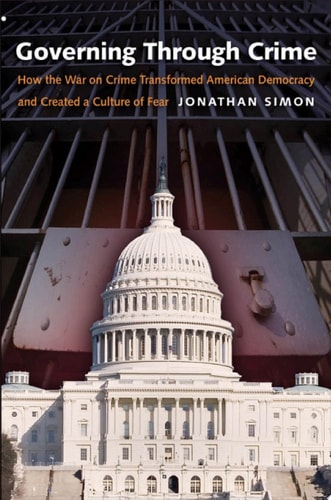
Governing Through Crime: How the War on Crime Transformed American Democracy and Created a Culture of Fear
0
0
As an Amazon Associate and affiliate partner, Menrva Books earns from qualifying purchases. Learn more
Author Description
Across America today gated communities sprawl out from urban centers, employers enforce mandatory drug testing, and schools screen students with metal detectors. Social problems ranging from welfare dependency to educational inequality have been reconceptualized as crimes, with an attendant focus on assigning fault and imposing consequences. Even before the recent terrorist attacks, non-citizen residents had become subject to an increasingly harsh regime of detention and deportation, and prospective employees subjected to background checks. How and when did our everyday world become dominated by fear, every citizen treated as a potential criminal?In this startlingly original work, Jonathan Simon traces this pattern back to the collapse of the New Deal approach to governing during the 1960s when declining confidence in expert-guided government policies sent political leaders searching for new models of governance. The War on Crime offered a ready solution to their problem: politicians set agendas by drawing analogies to crime and redefined the ideal citizen as a crime victim, one whose vulnerabilities opened the door to overweening government intervention. By the 1980s, this transformation of the core powers of government had spilled over into the institutions that govern daily life. Soon our schools, our families, our workplaces, and our residential communities were being governed through crime.This powerful work concludes with a call for passive citizens to become engaged partners in the management of risk and the treatment of social ills. Only by coming together to produce security, can we free ourselves from a logic of domination by others, and from the fear that currently rules our everyday life.
Menrva's Summary
THE THESIS
This book investigates how the American political system shifted from New Deal-era social management to a governance model centered on crime control and the cultivation of fear. Jonathan Simon, a professor of law and criminology, analyzes the historical transition beginning in the 1960s, arguing that political leaders adopted the 'War on Crime' as a primary framework to maintain authority. He posits that this shift fundamentally altered the relationship between the state and the individual, recasting citizens as either potential criminals or vulnerable victims in need of protection.
THE SCOPE MAP
What You Will Find
- Historical analysis of the collapse of New Deal governance in the 1960s.
- Examination of how crime-based logic infiltrated schools, workplaces, and residential communities.
- Discussion of the political utility of the 'crime victim' archetype in shaping public policy.
- Proposals for shifting from a culture of fear to a model of collaborative risk management.
THE AUTHORITY PERSPECTIVE
Scholars and critics recognize this work as a critical contribution to the study of American institutional development and the expansion of the penal state. Readers frequently note the academic density of the prose, which provides a rigorous framework for understanding the intersection of political strategy and social control.
Page Count:
340
Publication Date:
2007-01-01
Publisher:
Oxford University Press
ISBN-10:
0199884560
ISBN-13:
9780199884568
History
Criminology
Administration of Justice
Public Policy
Law
American History
Sociology
Community Tags
Similar Books