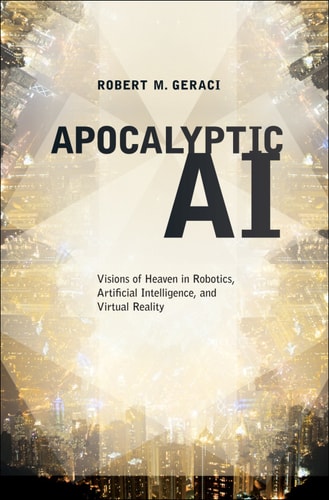
Apocalyptic AI: Visions of Heaven in Robotics, Artificial Intelligence, and Virtual Reality
0
0
As an Amazon Associate and affiliate partner, Menrva Books earns from qualifying purchases. Learn more
Author Description
Apocalyptic AI, the hope that we might one day upload our minds into machines or cyberspace and live forever, is a surprisingly wide-spread and influential idea, affecting everything from the world view of online gamers to government research funding and philosophical thought. In Apocalyptic AI, Robert Geraci offers the first serious account of this "cyber-theology" and the people who promote it. Drawing on interviews with roboticists and AI researchers and with devotees of the online game Second Life, among others, Geraci illuminates the ideas of such advocates of Apocalyptic AI as Hans Moravec and Ray Kurzweil. He reveals that the rhetoric of Apocalyptic AI is strikingly similar to that of the apocalyptic traditions of Judaism and Christianity. In both systems, the believer is trapped in a dualistic universe and expects a resolution in which he or she will be translated to a transcendent new world and live forever in a glorified new body. Equally important, Geraci shows how this worldview shapes our culture. Apocalyptic AI has become a powerful force in modern culture. In this superb volume, he shines a light on this belief system, revealing what it is and how it is changing society.
Menrva's Summary
THE THESIS
This book investigates the emergence of 'Apocalyptic AI' as a modern secular theology that mirrors traditional religious expectations of transcendence and immortality. Robert M. Geraci, a scholar of religion and technology, utilizes a framework that bridges the gap between computational science and theological history. He argues that the desire to upload human consciousness into digital substrates is not merely a technical goal but a belief system rooted in dualistic traditions. By examining the rhetoric of prominent futurists and the practices of virtual world participants, he demonstrates how these technological aspirations function as a contemporary form of salvation.
THE SCOPE MAP
What You Will Find
- Analysis of the 'cyber-theology' movement and its parallels to Judeo-Christian apocalyptic traditions.
- Case studies involving interviews with roboticists, AI researchers, and participants in virtual environments like Second Life.
- Examination of the philosophical and cultural influence of figures such as Hans Moravec and Ray Kurzweil.
- Exploration of how the promise of digital immortality shapes modern funding, research priorities, and societal worldviews.
THE AUTHORITY PERSPECTIVE
Experts in the field of religion and technology recognize this work as a foundational text for understanding the intersection of digital culture and human belief. Readers frequently note the clarity with which Geraci connects complex technical projections to historical religious patterns.
Page Count:
246
Publication Date:
2010-01-01
Publisher:
Oxford University Press
ISBN-10:
0199889414
ISBN-13:
9780199889419
Religion
Philosophy
Sociology
Technology
Robotics
Community Tags
Similar Books