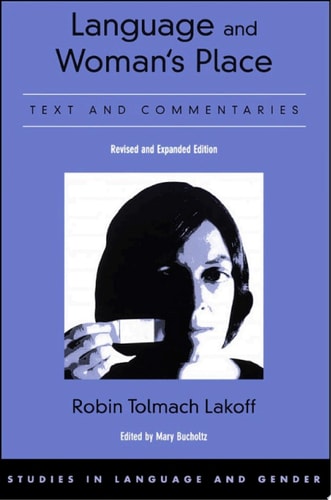
Language and Woman's Place: Text and Commentaries
0
0
As an Amazon Associate and affiliate partner, Menrva Books earns from qualifying purchases. Learn more
Author Description
The 1975 publication of Robin Tolmach Lakoff's Language and Woman's Place, is widely recognized as having inaugurated feminist research on the relationship between language and gender, touching off a remarkable response among language scholars, feminists, and general readers. For the past thirty years, scholars of language and gender have been debating and developing Lakoff's initial observations.Arguing that language is fundamental to gender inequality, Lakoff pointed to two areas in which inequalities can be found: Language used about women, such as the asymmetries between seemingly parallel terms like master and mistress, and language used by women, which places women in a double bind between being appropriately feminine and being fully human. Lakoff's central argument that "women's language" expresses powerlessness triggered a controversy that continues to this day.The revised and expanded edition presents the full text of the original first edition, along with an introduction and annotations by Lakoff in which she reflects on the text a quarter century later and expands on some of the most widely discussed issues it raises. The volume also brings together commentaries from twenty-six leading scholars of language, gender, and sexuality, within linguistics, anthropology, modern languages, education, information sciences, and other disciplines. The commentaries discuss the book's contribution to feminist research on language and explore its ongoing relevance for scholarship in the field.This new edition of Language and Woman's Place not only makes available once again the pioneering text of feminist linguistics; just as important, it places the text in the context of contemporary feminist and gender theory for a new generation of readers.
Menrva's Summary
THE THESIS
Does the structure of language inherently reinforce gender inequality and the social marginalization of women? Robin Tolmach Lakoff, a pioneering linguist, examines how language used about women and language used by women creates a double bind that limits female agency. By analyzing linguistic asymmetries and the perceived powerlessness in feminine speech patterns, the author provides a foundational framework for understanding the intersection of gender and discourse.
THE SCOPE MAP
What You Will Find
- A complete reproduction of the original 1975 seminal text on feminist linguistics.
- Annotations and reflective commentary by the author written twenty-five years after the initial publication.
- Twenty-six critical essays from interdisciplinary scholars in anthropology, education, and linguistics.
- An exploration of the double bind between feminine social expectations and human autonomy.
THE AUTHORITY PERSPECTIVE
Experts recognize this volume as a foundational text that inaugurated the field of language and gender studies. Readers frequently note the academic density of the prose while appreciating the inclusion of contemporary scholarly critiques that contextualize Lakoff's original arguments.
Page Count:
323
Publication Date:
2004-01-01
Publisher:
Oxford University Press
ISBN-10:
0199883300
ISBN-13:
9780199883301
English & College Success
English
Academic
Sociology
Womens Studies
Feminism
Communication
Linguistics
Gender Studies
Feminist Theory
Community Tags
Other Editions(3)
Similar Books









Reader Comments
Share Your Thoughts
No comments yet. Be the first to share your thoughts!