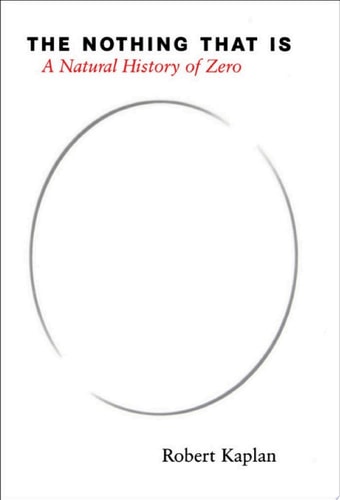
The Nothing That Is: A Natural History of Zero
0
0
As an Amazon Associate and affiliate partner, Menrva Books earns from qualifying purchases. Learn more
Author Description
A symbol for what is not there, an emptiness that increases any number it's added to, an inexhaustible and indispensable paradox. As we enter the year 2000, zero is once again making its presence felt. Nothing itself, it makes possible a myriad of calculations. Indeed, without zero mathematics as we know it would not exist. And without mathematics our understanding of the universe would be vastly impoverished. But where did this nothing, this hollow circle, come from? Who created it? And what, exactly, does it mean? Robert Kaplan's The Nothing That Is: A Natural History of Zero begins as a mystery story, taking us back to Sumerian times, and then to Greece and India, piecing together the way the idea of a symbol for nothing evolved. Kaplan shows us just how handicapped our ancestors were in trying to figure large sums without the aid of the zero. (Try multiplying CLXIV by XXIV). Remarkably, even the Greeks, mathematically brilliant as they were, didn't have a zero--or did they? We follow the trail to the East where, a millennium or two ago, Indian mathematicians took another crucial step. By treating zero for the first time like any other number, instead of a unique symbol, they allowed huge new leaps forward in computation, and also in our understanding of how mathematics itself works. In the Middle Ages, this mathematical knowledge swept across western Europe via Arab traders. At first it was called "dangerous Saracen magic" and considered the Devil's work, but it wasn't long before merchants and bankers saw how handy this magic was, and used it to develop tools like double-entry bookkeeping. Zero quickly became an essential part of increasingly sophisticated equations, and with the invention of calculus, one could say it was a linchpin of the scientific revolution. And now even deeper layers of this thing that is nothing are coming to light: our computers speak only in zeros and ones, and modern mathematics shows that zero alone can be made to generate everything
Menrva's Summary
THE THESIS
This book investigates the historical origins and mathematical necessity of the concept of zero, exploring how a symbol for nothingness became the foundation of modern calculation. Robert Kaplan, a mathematician and educator, traces the evolution of zero from its absence in ancient civilizations to its integration into global mathematical systems. He argues that the invention and acceptance of zero was not merely a technical advancement but a conceptual shift that enabled the scientific revolution and the development of modern computing.
THE SCOPE MAP
What You Will Find
- Historical analysis of mathematical systems in Sumerian, Greek, and Indian civilizations
- The transition of zero from a placeholder to a functional number
- The cultural and religious resistance to zero in medieval Europe
- The role of zero in the development of calculus and binary computation
THE AUTHORITY PERSPECTIVE
Experts and readers alike praise this work for its accessible prose and ability to make complex mathematical history engaging for a general audience. The text is frequently cited as a clear, narrative-driven introduction to the history of mathematics that successfully bridges the gap between technical theory and historical context.
Page Count:
237
Publication Date:
1999-01-01
Publisher:
Oxford University Press
ISBN-10:
0199880891
ISBN-13:
9780199880898
History
Philosophy
Science
Non-Fiction
Mathematics history
Mathematics
Earth Sciences
Mathematics - General
Mathematics Statistics
Number Theory
Community Tags
Similar Books