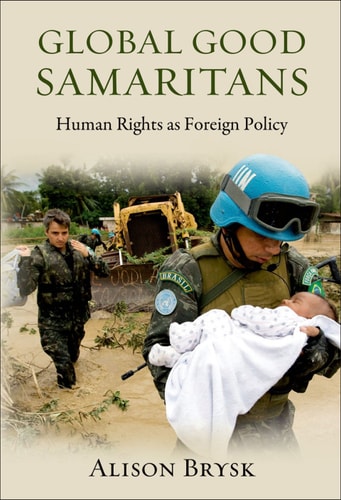
Global Good Samaritans: Human Rights as Foreign Policy
0
0
As an Amazon Associate and affiliate partner, Menrva Books earns from qualifying purchases. Learn more
Author Description
In a troubled world where millions die at the hands of their own governments and societies, some states risk their citizens' lives, considerable portions of their national budgets, and repercussions from opposing states to protect helpless foreigners. Dozens of Canadian peacekeepers have died in Afghanistan defending humanitarian reconstruction in a shattered faraway land with no ties to their own. Each year, Sweden contributes over $3 billion to aid the world's poorest citizens and struggling democracies, asking nothing in return. And, a generation ago, Costa Rica defied U.S. power to broker a peace accord that ended civil wars in three neighboring countries--and has now joined with principled peers like South Africa to support the United Nations' International Criminal Court, despite U.S. pressure and aid cuts. Hundreds of thousands of refugees are alive today because they have been sheltered by one of these nations. Global Good Samaritans looks at the reasons why and how some states promote human rights internationally, arguing that humanitarian internationalism is more than episodic altruism--it is a pattern of persistent principled politics. Human rights as a principled foreign policy defies the realist prediction of untrammeled pursuit of national interest, and suggests the utility of constructivist approaches that investigate the role of ideas, identities, and influences on state action. Brysk shows how a diverse set of democratic middle powers, inspired by visionary leaders and strong civil societies, came to see the linkage between their long-term interest and the common good. She concludes that state promotion of global human rights may be an option for many more members of the international community and that the international human rights regime can be strengthened at the interstate level, alongside social movement campaigns and the struggle for the democratization of global governance.
Menrva's Summary
THE THESIS
This book investigates why certain democratic middle powers prioritize the promotion of international human rights as a core component of their foreign policy despite the realist assumption that states act solely in their own national interest. Alison Brysk, a scholar of international relations and human rights, utilizes a constructivist framework to analyze how ideas, national identity, and strong civil societies influence state behavior. She argues that humanitarian internationalism is not merely episodic altruism but a persistent pattern of principled politics that links long-term national interests with the global common good.
THE SCOPE MAP
What You Will Find
- Comparative analysis of middle powers including Canada, Sweden, Costa Rica, and South Africa.
- Examination of the role of visionary leadership and civil society in shaping state foreign policy.
- Theoretical application of constructivist approaches to international relations.
- Discussion on the strengthening of the international human rights regime and the democratization of global governance.
THE AUTHORITY PERSPECTIVE
Experts recognize this work as a significant contribution to the study of middle-power diplomacy and the constructivist school of international relations. Readers frequently note the clarity with which Brysk bridges the gap between theoretical political science and practical case studies of state-led humanitarianism.
Page Count:
298
Publication Date:
2009-01-01
Publisher:
Oxford University Press
ISBN-10:
0199888752
ISBN-13:
9780199888757
Sociology
Foreign Policy
Human rights
International relations
Public Policy
Community Tags
Similar Books