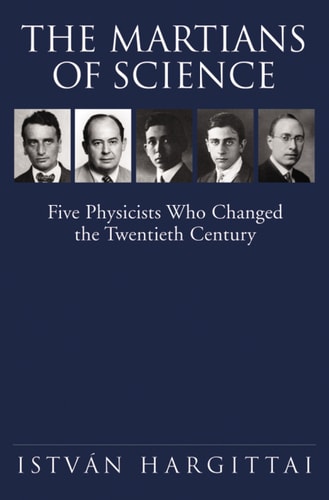
The Martians of Science: Five Physicists Who Changed the Twentieth Century
0
0
As an Amazon Associate and affiliate partner, Menrva Books earns from qualifying purchases. Learn more
Author Description
If science has the equivalent of a Bloomsbury group, it is the five men born at the turn of the twentieth century in Budapest: Theodore von Kármán, Leo Szilard, Eugene Wigner, John von Neumann, and Edward Teller. From Hungary to Germany to the United States, they remained friends and continued to work together and influence each other throughout their lives. As a result, their work was integral to some of the most important scientific and political developments of the twentieth century. István Hargittai tells the story of this remarkable group: Wigner won a Nobel Prize in theoretical physics; Szilard was the first to see that a chain reaction based on neutrons was possible, initiated the Manhattan Project, but left physics to try to restrict nuclear arms; von Neumann could solve difficult problems in his head and developed the modern computer for more complex problems; von Kármán became the first director of NASA's Jet Propulsion Laboratory, providing the scientific basis for the U.S. Air Force; and Teller was the father of the hydrogen bomb, whose name is now synonymous with the controversial "Star Wars" initiative of the 1980s. Each was fiercely opinionated, politically active, and fought against all forms of totalitarianism. Hargittai, as a young Hungarian physical chemist, was able to get to know some of these great men in their later years, and the depth of information and human interest in The Martians of Science is the result of his personal relationships with the subjects, their families, and their contemporaries.
Menrva's Summary
THE THESIS
This book investigates the collective influence and shared cultural background of five Hungarian-born physicists who fundamentally altered the trajectory of twentieth-century science and global politics. István Hargittai, a physical chemist, utilizes his unique access to these figures and their personal circles to construct a biographical study of Theodore von Kármán, Leo Szilard, Eugene Wigner, John von Neumann, and Edward Teller. The text examines how their shared intellectual upbringing in Budapest and their subsequent migration to the United States shaped their collaborative approach to complex problems in nuclear physics, computing, and aerospace engineering. Hargittai argues that their shared experience of fleeing totalitarianism informed both their scientific rigor and their intense political engagement throughout the Cold War era.
THE SCOPE MAP
What You Will Find
- Biographical profiles of five key figures: von Kármán, Szilard, Wigner, von Neumann, and Teller.
- Analysis of the scientific contributions to the Manhattan Project, modern computing, and aerospace development.
- Primary source insights derived from the author's personal interviews with the subjects and their families.
- Examination of the intersection between scientific research and twentieth-century geopolitical conflict.
THE AUTHORITY PERSPECTIVE
Experts and historians of science frequently cite this work as a valuable humanizing account of the individuals behind the most significant technological shifts of the last century. Readers often note the balance between technical biographical detail and the broader historical context of the era.
Page Count:
337
Publication Date:
2006-01-01
Publisher:
Oxford University Press
ISBN-10:
0199884412
ISBN-13:
9780199884414
History
Biography
Science
Non-Fiction
English & College Success
English
Physicists biography
Physics
Biography Autobiography
Community Tags
Similar Books