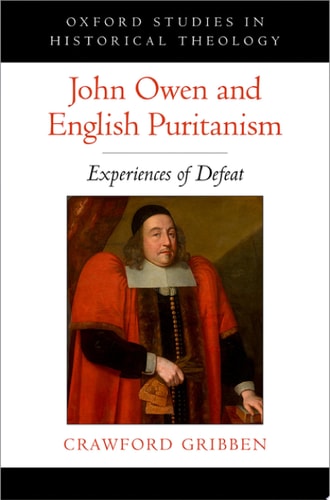
John Owen and English Puritanism: Experiences of Defeat
0
0
As an Amazon Associate and affiliate partner, Menrva Books earns from qualifying purchases. Learn more
Author Description
John Owen was a leading theologian in seventeenth-century England. Closely associated with the regicide and revolution, he befriended Oliver Cromwell, was appointed vice-chancellor of the University of Oxford, and became the premier religious statesman of the Interregnum. The restoration of the monarchy pushed Owen into dissent, criminalizing his religious practice and inspiring his writings in defense of high Calvinism and religious toleration. Owen transcended his many experiences of defeat, and his claims to quietism were frequently undermined by rumors of his involvement in anti-government conspiracies. Crawford Gribben's biography documents Owen's importance as a controversial and adaptable theologian deeply involved with his social, political, and religious environments. Fiercely intellectual and extraordinarily learned, Owen wrote millions of words in works of theology and exegesis. Far from personifying the Reformed tradition, however, Owen helped to undermine it, offering an individualist account of Christian faith that downplayed the significance of the church and means of grace. In doing so, Owen's work contributed to the formation of the new religious movement known as evangelicalism, where his influence can still be seen today.
Menrva's Summary
THE THESIS
This work investigates how John Owen, a prominent seventeenth-century theologian, navigated the political and religious shifts of the Interregnum and the Restoration to shape the trajectory of Reformed theology. Crawford Gribben, a scholar of early modern religious history, utilizes extensive archival research and analysis of Owen's voluminous writings to argue that Owen's experiences of political defeat were central to his theological development. The book posits that Owen's individualistic approach to faith, while rooted in high Calvinism, inadvertently laid the groundwork for modern evangelicalism by de-emphasizing traditional ecclesiastical structures.
THE SCOPE MAP
What You Will Find
- Analysis of John Owen's political involvement with Oliver Cromwell and the Interregnum government.
- Examination of Owen's transition from state-sanctioned leadership to the status of a religious dissenter.
- Evaluation of Owen's theological contributions to high Calvinism and his arguments for religious toleration.
- Discussion of the transition from Reformed orthodoxy to the early stages of evangelicalism.
Scope Limits
- The text does not provide a comprehensive history of the entire Puritan movement, focusing specifically on Owen's individual career.
- It does not offer a line-by-line exegesis of all of Owen's millions of words of writing.
THE AUTHORITY PERSPECTIVE
Scholars recognize this biography as a significant contribution to the study of seventeenth-century dissent and the intellectual history of the Reformed tradition. Readers frequently note the academic density of the prose and the author's ability to contextualize complex theological shifts within the volatile political landscape of the era.
Page Count:
401
Publication Date:
2016-01-01
Publisher:
Oxford University Press
ISBN-10:
0190613882
ISBN-13:
9780190613884
History
Religion
Biography
English
Great Britain
Biography Autobiography
Puritanism
English & College Success
Theology
Seventeenth Century
Christian History
Community Tags
Similar Books