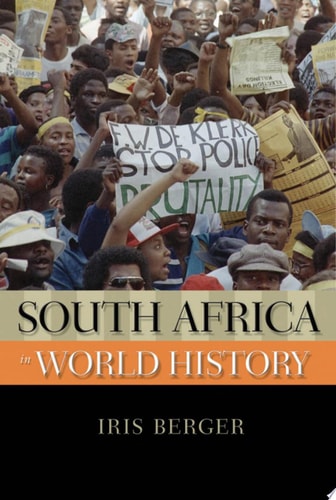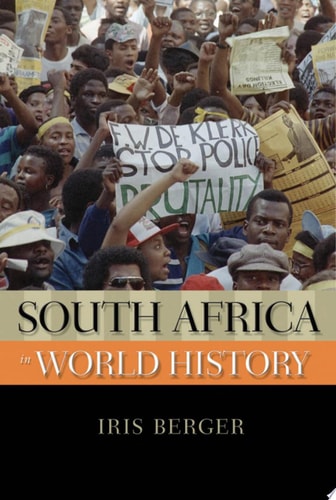
South Africa in World History (New Oxford World History)
0
0
As an Amazon Associate and affiliate partner, Menrva Books earns from qualifying purchases. Learn more
Author Description
This volume begins in the early centuries of the Common Era with the various groups of people who had settled in southern Africa. Stone Age foragers, farmers with iron technology, and pastoralists all interacted to create a complex society before Europeans arrived. In the seventeenth century, Dutch settlers developed a colonial society based on the menial labor of indigenous inhabitants of the Cape and slaves imported from the East Indies and other parts of Africa. British conquest in the early nineteenth century brought an end to slavery, as well as new forms of colonial domination, tension between the British and the original Dutch settlers, armed struggle between expanding European communities and Africans (including the highly militarized Zulu kingdom), and intensive missionary activity that transformed many African societies. The discovery of diamonds and gold in the late nineteenth century brought industrialization based on migrant labor, new clashes between British and Africaaners, the final conquest of African societies, and new European migrants. During the twentieth-century, despite further economic development, African communities were increasingly impoverished. New forms of racial domination lead to the implementation of apartheid in 1948 and heightened political organizing among both African and Africaaner nationalists. The intensification of resistance in the 1970s and '80s coupled with drastic changes in the international balance of power brought an end to the apartheid state in 1994 and an intensified struggle to overcome apartheid's economic and political legacy by building a new nonracial society. The book emphasizes social and cultural history, focusing on people's interactions and identities according to race, class, gender, religion and ethnicity. It also addresses changes in literature (both oral and written), music, and the arts and draws on the extensive biographical and autobiographical literature to provide a personal focus for the discussion.
Menrva's Summary
THE THESIS
This volume investigates the complex historical trajectory of South Africa, examining how internal social dynamics and global interactions shaped the nation from the early Common Era to the post-apartheid era. Author Iris Berger, a distinguished historian of African history, utilizes a synthesis of archaeological, archival, and biographical data to construct this narrative. The work argues that South Africa's development is defined by the shifting intersections of race, class, gender, and ethnicity, rather than merely a linear progression of political events. By integrating cultural and social perspectives, Berger provides a framework for understanding the country's transition from colonial domination to a modern, nonracial state.
THE SCOPE MAP
What You Will Find
- A comprehensive chronological survey of southern Africa from the early centuries of the Common Era through the 1994 democratic transition.
- Analysis of the socio-economic impacts of industrialization, specifically the discovery of diamonds and gold and the subsequent migrant labor systems.
- Examination of cultural shifts, including the evolution of oral and written literature, music, and the arts within diverse communities.
- A thematic focus on the mechanisms of racial domination, the implementation of apartheid, and the subsequent resistance movements.
THE AUTHORITY PERSPECTIVE
Scholars and educators frequently cite this work as a balanced and accessible entry point for students seeking to understand the multifaceted history of South Africa. The text is noted for its ability to weave personal narratives into broader historical trends, making it a standard reference for those interested in the social and cultural dimensions of the region.
Page Count:
207
Publication Date:
2009-01-01
Publisher:
Oxford University Press
ISBN-10:
0199887586
ISBN-13:
9780199887583
History
South Africa
Social History
World history
African history
Cultural History
Community Tags
Similar Books