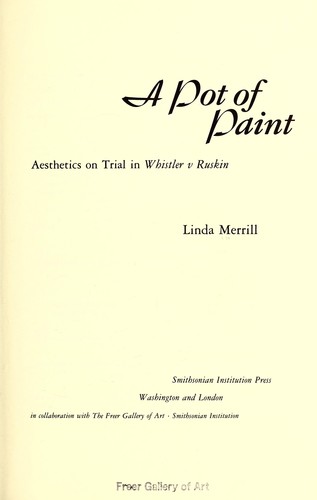
A Pot of Paint
0
0
As an Amazon Associate and affiliate partner, Menrva Books earns from qualifying purchases. Learn more
Author Description
A Pot of Paint reconstructs the lost transcript and revisits the highly contested issues surrounding one of the most celebrated trials in the history of art. A libel suit brought in the London courts by American expatriate artist James McNeill Whistler against John Ruskin, England's most powerful art critic, the trial was essentially a debate of aesthetic theory conducted at a critical hour in the evolution of modern art. After viewing an 1877 exhibition that included some of Whistler's most abstract works, Ruskin declared in print that the artist had flung "a pot of paint in the public's face." He called Whistler a "coxcomb" and said that it was the height of "cockney impudence" to ask two hundred guineas for a painting such as Nocturne in Black and Gold: The Falling Rocket. The dispute was fully covered in the popular press. Using those newspaper accounts, as well as letters, legal papers, Ruskin's instructions to his counsel, and Whistler's later rendition of events in The Gentle Art of Making Enemies, Linda Merrill reveals the deeply held, contrary aesthetic ideals of the two parties, and shows that, in many ways, the real litigants in Whistler v. Ruskin were traditional, representational art and art that tended toward abstraction. During eighteen months of pretrial delays and two days of testimony from Whistler and several well-known figures in the art world, London debated the value and the meaning of art. A Pot of Paint retrieves these debates for a society that continues to argue the merits of innovation in art and the place of art in the modern world.
Menrva's Summary
THE THESIS
A libel suit brought by artist James McNeill Whistler against art critic John Ruskin becomes a pivotal debate on aesthetic theory and the evolution of modern art. The trial, sparked by Ruskin's scathing review of Whistler's abstract work,
THE SCOPE MAP
- A reconstruction of the lost transcript from the Whistler v. Ruskin libel trial.
- An examination of the contested issues surrounding one of the most celebrated trials in art history.
- Analysis of the libel suit brought by American expatriate artist James McNeill Whistler against England's most powerful art critic, John Ruskin.
- Exploration of the aesthetic theory debate conducted at a critical hour in the evolution of modern art.
- Use of newspaper accounts, letters, legal papers, and Ruskin's instructions to his counsel.
- Whistler's later rendition of events in 'The Gentle Art of Making Enemies'.
- Discussion of the contrary aesthetic ideals of Whistler and Ruskin, representing representational art versus abstract art.
THE AUTHORITY PERSPECTIVE
A Pot of Paint meticulously reconstructs the Whistler v. Ruskin trial, a landmark event that pitted traditional art against emerging abstraction. Linda Merrill's work delves into the legal and aesthetic arguments, utilizing a range of primary sources to illuminate the deeply held, opposing artistic philosophies. The book positions the trial not just as a personal dispute but as a broader societal debate on the value and meaning of art in a rapidly changing modern world. It retrieves these historical arguments for contemporary readers who continue to grapple with innovation in art.
Page Count:
419
Publication Date:
1992-01-01
ISBN-10:
1560981016
Biography
Non-Fiction
History
Art History
Legal History
Community Tags
Similar Books














