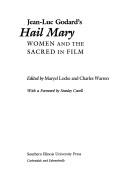
Jean-Luc Godard's Hail Mary
0
0
As an Amazon Associate and affiliate partner, Menrva Books earns from qualifying purchases. Learn more
Author Description
Maryel Locke and Charles Warren present twelve original essays by film critics, filmmakers, theologians, and philosophers that examine the 1985 film Hail Mary, directed by Jean-Luc Godard, and its companion film, The Book of Mary, directed by Anne-Marie Mieville. (The films are released under the one title Hail Mary) The interpretative essays offer a rich spectrum of analysis and opinion representing many divergent points of view about critical theory, the status of women, and the value of film as a medium. Locke and Warren also include two important interviews with Godard, brief biographies and complete filmographies of Godard and Mieville, a shot breakdown of the two films with the English subtitles, and the script of the French dialogue to complete a remarkably comprehensive treatment of these important films. The only film based on the biblical story of the Virgin Mary, Godard's Hail Mary is a contemporary Swiss/French representation of Mary's virgin pregnancy, the birth of her son, and her relationship to Joseph and her young child. Mieville's companion film is about a young girl named Mary whose parents get a divorce. While neither film is overtly religious, the initial release of Hail Mary brought public protests, court cases, a physical attack on Godard, and condemnation by the Pope. An insight emerging compellingly from the volume as a whole is that the camera, which possesses the capacity to invoke the mystery of human sexuality, itself partakes of, incarnates, the mystery of sexual difference. That is a fundamental fact about the medium of film, but a fact that current film theory, with its incessant identifications of the camera as masculine, denies. This is the central claim that, in the context of contemporary film study, gives the book a sharp critical edge and that seems likely to provoke considerable comment within the field.
Menrva's Summary
THE THESIS
*This volume critically examines Jean-Luc Godard's 1985 film Hail Mary and its companion piece, The Book of Mary.* The essays, contributed by a diverse group of scholars and artists, explore the films through lenses of critical theory, the status of women, and film's inherent nature as a medium. The book also includes interviews with Godard, biographical information on Godard and Anne-Marie Mieville, and detailed breakdowns of the films' content, including scripts and shot analyses. The central argument posits that film's camera, often theorized as masculine, actually embodies the mystery of sexual difference, a claim that provides the work with a significant critical edge in contemporary film studies.
THE SCOPE MAP
- Analysis of Jean-Luc Godard's 1985 film Hail Mary
- Examination of Anne-Marie Mieville's companion film, The Book of Mary
- Essays on critical theory and its application to film
- Discussions on the status of women and feminist perspectives
- Exploration of film as a medium and its inherent properties
- Interviews with Jean-Luc Godard
- Biographies and filmographies of Jean-Luc Godard and Anne-Marie Mieville
- Detailed shot breakdown and script of the films
THE AUTHORITY PERSPECTIVE
This collection is likely to be highly regarded within academic circles, particularly in film studies and critical theory, due to its in-depth analysis of Godard's controversial work. The inclusion of diverse viewpoints and the central argument regarding the camera's embodiment of sexual difference suggest it will provoke significant scholarly debate. The comprehensive nature of the supplementary materials, such as interviews and film breakdowns, further solidifies its value as a resource for understanding these specific films. The book's critical edge and engagement with contemporary theoretical discussions position it as a key text for those interested in the intersection of film, philosophy, and gender studies.
Page Count:
256
Publication Date:
1993-01-01
ISBN-10:
0809318245
ISBN-13:
9780809318247
Philosophy
Non-Fiction
History
Art
Feminist Theory
Film Studies
Theology
Community Tags
Similar Books