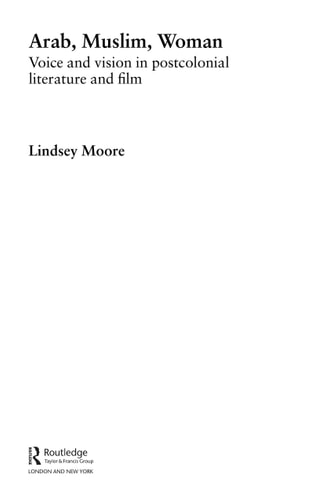
Arab, Muslim, Woman: Voice and Vision in Postcolonial Literature and Film
0
0
As an Amazon Associate and affiliate partner, Menrva Books earns from qualifying purchases. Learn more
Author Description
Given a long history of representation by others, what themes and techniques do Arab Muslim women writers, filmmakers and visual artists foreground in their presentation of postcolonial experience? Lindsey Moore’s book demonstrates ways in which women appropriate textual and visual modes of representation, often in cross-fertilizing ways, in challenges to Orientalist/colonialist, nationalist, Islamist, and ‘multicultural’ paradigms. She provides an accessible but theoretically-informed analysis by foregrounding tropes of vision, visibility and voice; post-nationalist melancholia and mother/daughter narratives; transformations of ‘homes and harems’; and border crossings in time, space, language, and media. In doing so, Moore moves beyond notions of speaking or looking ‘back’ to encompass a diverse feminist poetics and politics and to emphasize ethical forms of representation and reception. Arab, Muslim, Woman is distinctive in the eclectic body of work that it brings together. Discussing Algeria, Egypt, Jordan, Lebanon, Morocco, the Palestinian territories, and Tunisia, as well as postcolonial Europe, Moore argues for better integration of Arab Muslim contexts in the postcolonial canon. In a book for readers interested in women's studies, history, literature, and visual media, we encounter work by Assia Djebar, Mona Hatoum, Fatima Mernissi, Ahlam Mosteghanemi, Nawal el Saadawi, Leila Sebbar, Zineb Sedira, Ahdaf Soueif, Moufida Tlatli, Fadwa Tuqan, and many other women.
Menrva's Summary
THE THESIS
This work investigates how Arab Muslim women artists and writers utilize textual and visual media to reclaim their own representation from historical colonialist and nationalist paradigms. Lindsey Moore, a scholar in postcolonial studies, examines the intersection of gender, religion, and national identity through a diverse array of creative works. By analyzing how these women navigate and subvert Orientalist tropes, Moore argues for a more nuanced understanding of postcolonial experience that prioritizes the agency of the female subject.
THE SCOPE MAP
What You Will Find
- Analysis of literature, film, and visual art from Algeria, Egypt, Jordan, Lebanon, Morocco, the Palestinian territories, and Tunisia.
- Theoretical frameworks regarding the politics of voice, visibility, and the subversion of the 'harem' trope.
- Examination of post-nationalist melancholia and mother-daughter narratives within cross-cultural contexts.
- Critical engagement with the works of prominent figures such as Assia Djebar, Mona Hatoum, and Nawal el Saadawi.
THE AUTHORITY PERSPECTIVE
Scholars and students of postcolonial literature frequently cite this text for its ability to bridge the gap between visual media and written narrative. It is widely regarded as a significant contribution to the integration of Arab Muslim perspectives within broader postcolonial academic discourse.
Page Count:
208
Publication Date:
2008-01-01
Publisher:
Routledge
ISBN-10:
0203927729
ISBN-13:
9780203927724
Muslim Women
Film Studies
Literary Criticism
Feminist Theory
Women Arab
Feminism