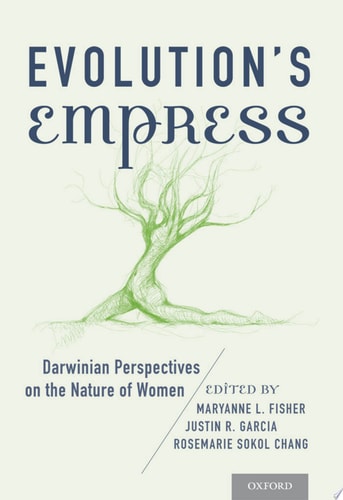
Evolution's Empress: Darwinian Perspectives on the Nature of Women
0
0
As an Amazon Associate and affiliate partner, Menrva Books earns from qualifying purchases. Learn more
Author Description
Over the last decade, there has been increasing debate as to whether feminism and evolutionary psychology can co-exist. Such debates often conclude with a resounding "no," often on the grounds that the former is a political movement while the latter is a field of scientific inquiry. In the midst of these debates, there has been growing dissatisfaction within the field of evolutionary psychology about the way the discipline (and others) have repeatedly shown women to be in passive roles when it comes to survival and reproduction. Evolutionary behavioral research has made significant strides in the past few decades, but continues to take for granted many theoretical assumption that are perhaps, in light of the most recent evidence, misguided. As a result, the research community has missed important areas of research, and in some cases, will likely come to inaccurate conclusions based on existing dogma, rather than rigorous, theoretically driven research. Bias in the field of evolutionary psychology echoes the complaints against the political movement attached to academic feminisms. This is an intellectual squabble where much is at stake, including a fundamental understanding of the evolutionary significance of women's roles in culture, mothering, reproductive health and physiology, mating, female alliances, female aggression, and female intrasexual competition.Evolution's Empress identifies women as active agents within the evolutionary process. The chapters in this volume focus on topics as diverse as female social interactions, mate competition and mating strategies, motherhood, women's health, sex differences in communication and motivation, sex discrimination, and women in literature. The volume editors bring together a diverse range of perspectives to demonstrate ways in which evolutionary approaches to human behavior have thus far been too limited. By reconsidering the role of women in evolution, this volume furthers the goal of generating dialogue between the r
Menrva's Summary
THE THESIS
This volume investigates whether evolutionary psychology can reconcile with feminist theory to provide a more accurate, active account of women's roles in human evolution. The editors, Justin R. Garcia, Maryanne L. Fisher, and Rosemarie Sokol Chang, argue that traditional evolutionary research has historically marginalized women by casting them in passive roles. By challenging existing dogmas and theoretical assumptions, the contributors propose a more rigorous, evidence-based framework that recognizes women as active agents in reproductive, social, and cultural processes.
THE SCOPE MAP
What You Will Find
- Analysis of female social interactions and intrasexual competition.
- Examination of motherhood, reproductive health, and physiology.
- Discussion of sex differences in communication, motivation, and aggression.
- Critique of historical biases in evolutionary behavioral research.
- Exploration of women's roles in literature and cultural contexts.
THE AUTHORITY PERSPECTIVE
Experts recognize this volume as a significant intervention in the discourse surrounding gender and evolutionary biology. Readers frequently note the academic density of the prose and the breadth of the interdisciplinary perspectives presented by the contributors.
Page Count:
512
Publication Date:
2013-01-01
Publisher:
Oxford University Press
ISBN-10:
019989275X
ISBN-13:
9780199892754
Science
Sociology
Evolutionary Psychology
Anthropology
Feminism
Gender Studies
Community Tags
Similar Books












Reader Comments
Share Your Thoughts
No comments yet. Be the first to share your thoughts!