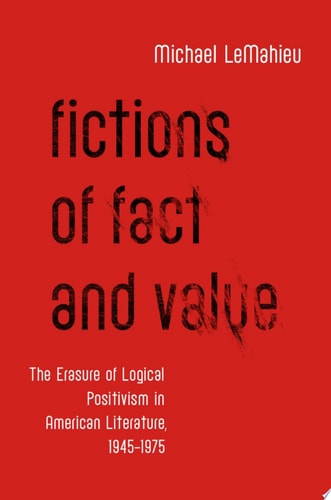
Fictions of Fact and Value: The Erasure of Logical Positivism in American Literature, 1945-1975
0
0
As an Amazon Associate and affiliate partner, Menrva Books earns from qualifying purchases. Learn more
Author Description
Fictions of Fact and Value argues that the philosophy of logical positivism, considered the antithesis of literary postmodernism, exerts a determining influence on the development of American fiction in the three decades following 1945, in what amounts to a constitutive encounter between literature and philosophy at mid-century: after the end of modernism, as it was traditionally conceived, but prior to the rise of postmodernism, as it came to be known. Two particular postwar literary preoccupations derive from logical positivist philosophy: the fact/value problem and the correlative distinction between sense and nonsense. Even as postwar writers responded to logical positivism as a threat to the imagination, their works often manifest its influence, specifically with regard to "emotive" or "meaningless" terms. Far from a straightforward history of ideas, Fictions of Fact and Value charts a genealogy that is often erased in the very texts where it registers and disowned by the very authors that it includes. LeMahieu complicates a predominant narrative of intellectual history in which a liberating postmodernism triumphs over a reactionary positivism by historicizing the literary response to positivism in works by John Barth, Saul Bellow, Don DeLillo, Iris Murdoch, Flannery O'Connor, Thomas Pynchon, and Ludwig Wittgenstein. As LeMahieu compelling demonstrates, the centrality of the fact/value problem to both positivism and postmodernism demands a rethinking of postwar literary history.A trenchantly argued study that unearths an important part of postwar literary history, Fictions of Fact and Value will interest anyone concerned with postmodernism, modernist studies, analytic philosophy, or the history of ideas.
Menrva's Summary
THE THESIS
This book investigates how the philosophy of logical positivism, often viewed as the antithesis of postmodernism, fundamentally shaped the development of American literature between 1945 and 1975. Michael LeMahieu, a scholar of modernist and postwar literature, utilizes a rigorous historical framework to challenge the standard narrative that postmodernism simply replaced a reactionary positivism. By examining the fact/value problem and the distinction between sense and nonsense, LeMahieu argues that postwar authors were deeply influenced by the very philosophical movement they sought to reject.
THE SCOPE MAP
What You Will Find
- An analysis of the fact/value problem as a central tension in postwar American fiction.
- A genealogy of logical positivism's influence on literary definitions of sense and nonsense.
- Case studies of major authors including John Barth, Saul Bellow, Don DeLillo, Iris Murdoch, Flannery O'Connor, and Thomas Pynchon.
- A re-evaluation of the transition period between modernism and postmodernism in intellectual history.
THE AUTHORITY PERSPECTIVE
Scholars and critics recognize this work as a significant intervention in postwar literary studies that successfully bridges the gap between analytic philosophy and literary history. Readers frequently note the academic density of the prose, which is considered a foundational text for those studying the intersection of mid-century philosophy and fiction.
Page Count:
256
Publication Date:
2013-01-01
Publisher:
Oxford University Press
ISBN-10:
0199890412
ISBN-13:
9780199890415
Philosophy
English & College Success
American
Literary Criticism
History of Ideas
English
Postmodernism
Community Tags
Other Editions(2)

Similar Books








Reader Comments
Share Your Thoughts
No comments yet. Be the first to share your thoughts!