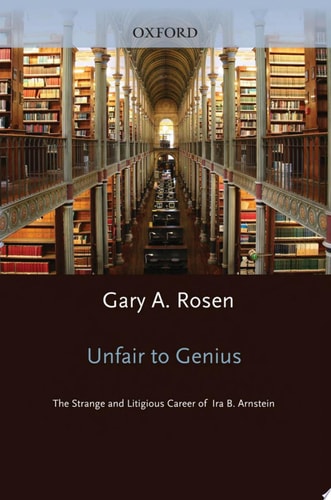
Unfair to Genius: The Strange and Litigious Career of Ira B. Arnstein
0
0
As an Amazon Associate and affiliate partner, Menrva Books earns from qualifying purchases. Learn more
Author Description
The long and tortured career of Ira B. Arnstein, "the unrivaled king of copyright infringement plaintiffs," opens a curious window into the evolution of copyright law in the United States. As Gary A. Rosen shows in this frequently funny and always entertaining history, the litigious Arnstein was a trenchant observer and most improbable participant in the transformation of not just copyright, but of American popular music itself. A musical prodigy in the late nineteenth century, Arnstein performed as a boy soprano at the famous 1893 "White City" exhibition in Chicago. He grew up to be a composer of moderate accomplishment, but by the mid-1920s his fortunes had reversed in the face of changing tastes and times. Embittered and confused, he became convinced that he was the victim of a conspiracy to steal his music and set out on a three-decade-long campaign to prove it, suing most of the major players in the popular music industry of his day.Although Arnstein never won a case, Rosen shows that the decisions rendered ultimately defined some of the basic parameters of copyright law. His most consequential case, against a dumbfounded Cole Porter, established precedents that have provided the foundation for successful suits against George Harrison, Michael Bolton, and many others.Unfair to Genius alternates the stories of Arnstein and a colorful cast of supporting characters with a fascinating account of the economic, technological, and legal forces of the first half of the twentieth century that shifted the balance of power from the mercenary music publishers of Tin Pan Alley to the composers and lyricists who wrote the Great American Songbook.
Menrva's Summary
THE THESIS
How did the litigious career of a failed composer inadvertently shape the foundational precedents of American copyright law? Gary Rosen, an expert in legal history, examines the life of Ira B. Arnstein to illustrate the chaotic evolution of intellectual property rights in the early twentieth century. By analyzing court records and the shifting landscape of the music industry, Rosen argues that Arnstein’s obsessive, unsuccessful lawsuits against major composers established the legal framework still used to adjudicate modern copyright infringement claims.
THE SCOPE MAP
What You Will Find
- A detailed history of the American music industry from the late nineteenth century through the mid-twentieth century.
- An analysis of the legal precedents established by the Arnstein v. Porter case.
- Primary source research into court transcripts and historical legal filings.
- An exploration of the transition of power from Tin Pan Alley publishers to individual songwriters.
THE AUTHORITY PERSPECTIVE
Legal scholars and music historians frequently cite this work for its ability to synthesize complex copyright doctrine with an engaging biographical narrative. Experts highlight the book as a valuable resource for understanding how persistent, albeit unsuccessful, litigation can fundamentally alter the trajectory of judicial interpretation.
Page Count:
319
Publication Date:
2012-01-01
Publisher:
Oxford University Press
ISBN-10:
0199910588
ISBN-13:
9780199910588
History
Biography
Music
Copyright
Business Aspects
Humanities
Law
Fair Use Copyright
Legal History
American History
Copyright music
Professional Career & Trade
Community Tags
Similar Books