The Frontier Club: Popular Westerns and Cultural Power, 1880-1924
0
0
As an Amazon Associate and affiliate partner, Menrva Books earns from qualifying purchases. Learn more
Author Description
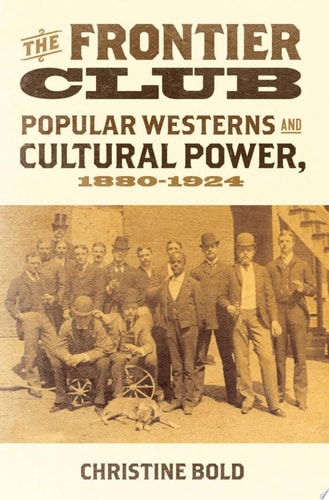
From Hollywood films to novels by Louis L'Amour and television series like Gunsmoke and Deadwood, the Wild West has exerted a powerful hold on the cultural imagination of the United States. Beginning with Theodore Roosevelt's founding of the Boone and Crockett Club in 1887, Christine Bold traces the origins and evolution of the western genre, revealing how a group of prominent eastern aristocrats-a cadre she terms "the frontier club" -created and propagated the myth of the Wild West to advance their own self-interest as well as larger systems of privilege and exclusion. Mining institutional archives, personal papers, novels, and films, The Frontier Club excavates the hidden social, political, and financial interests behind the making of the modern western. It re-reads frontier-club fiction, most notably Owen Wister's bestseller The Virginian, in relation to federal policies and cultural spaces (from exclusive gentlemen's clubs to national parks to zoos); it casts new light on key clubmen, both the famous and the forgotten-figures such as Roosevelt, George Bird Grinnell, Silas Weir Mitchell, Henry Cabot Lodge, and Frederic Remington-while recovering the women on whom these men depended and without whom this version of the popular West would not exist; and it considers the costs of the frontier-club formula, in terms of its impact on Indigenous peoples and its marginalization of other popular voices, including western writings by African Americans, women, and working-class white men. An engaging cultural history that covers print culture, big-game hunting, politics, immigration, Jim Crow segregation, and environmental conservation at the turn of the twentieth century, The Frontier Club provides a welcome new perspective on the enduring American myth of the Wild West.
Menrva's Summary
THE THESIS
This work investigates how a specific group of eastern aristocrats, termed the frontier club, constructed and disseminated the myth of the American Wild West to consolidate social, political, and economic power. Christine Bold, a scholar of American literature and culture, utilizes a diverse array of primary sources—including institutional archives, personal correspondence, and popular fiction—to argue that the western genre was not merely entertainment but a calculated instrument of privilege. By examining the intersection of federal policy, environmental conservation, and exclusionary social practices, the author demonstrates how this elite cadre shaped national identity to serve their own interests.
THE SCOPE MAP
What You Will Find
- An analysis of the influence of elite eastern gentlemen's clubs on the development of the western genre.
- A critical re-reading of foundational texts like Owen Wister's The Virginian in the context of Jim Crow and immigration policy.
- Examination of the roles played by figures such as Theodore Roosevelt, George Bird Grinnell, and Frederic Remington.
- Documentation of the marginalization of Indigenous, African American, and working-class perspectives within the established western canon.
THE AUTHORITY PERSPECTIVE
Scholars and cultural historians frequently cite this text for its rigorous archival research and its ability to connect literary output to broader political agendas. It is widely regarded as a significant contribution to the study of American myth-making and the sociology of the western genre.
Page Count:
318
Publication Date:
2013-01-01
Publisher:
Oxford University Press
ISBN-10:
0199913021
ISBN-13:
9780199913022
History
American History
In literature
Literary Criticism
Westerns
Community Tags
Similar Books