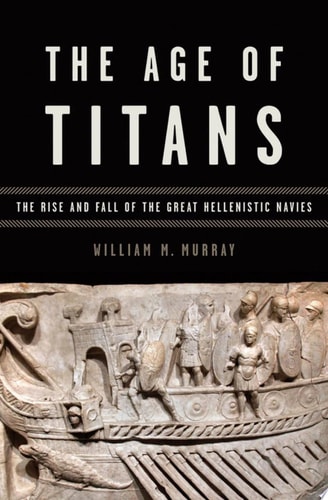
The Age of Titans: The Rise and Fall of the Great Hellenistic Navies
0
0
As an Amazon Associate and affiliate partner, Menrva Books earns from qualifying purchases. Learn more
Author Description
While we know a great deal about naval strategies in the classical Greek and later Roman periods, our understanding of the period in between--the Hellenistic Age--has never been as complete. However, thanks to new physical evidence discovered in the past half-century and the construction of Olympias, a full-scale working model of an Athenian trieres (trireme) by the Hellenic Navy during the 1980s, we now have new insights into the evolution of naval warfare following the death of Alexander the Great. In what has been described as an ancient naval arms race, the successors of Alexander produced the largest warships of antiquity, some as long as 400 feet carrying as many as 4000 rowers and 3000 marines. Vast, impressive, and elaborate, these warships "of larger form"--as described by Livy--were built not just to simply convey power but to secure specific strategic objectives. When these particular factors disappeared, this "Macedonian" model of naval power also faded away--that is, until Cleopatra and Mark Antony made one brief, extravagant attempt to reestablish it, an endeavor Octavian put an end to once and for all at the battle of Actium. Representing the fruits of more than thirty years of research, The Age of Titans provides the most vibrant account to date of Hellenistic naval warfare.
Menrva's Summary
THE THESIS
This work investigates the evolution, strategic utility, and eventual decline of the massive warships developed by the successors of Alexander the Great during the Hellenistic Age. William M. Murray, a scholar of ancient naval warfare, synthesizes decades of research to explain why these colossal vessels were constructed and how they functioned within the geopolitical landscape of the Mediterranean. By analyzing new physical evidence and the experimental data provided by the reconstruction of the trireme Olympias, the author constructs a framework for understanding the ancient naval arms race that defined the era.
THE SCOPE MAP
What You Will Find
- Analysis of the naval arms race following the death of Alexander the Great.
- Technical evaluation of the construction and operation of Hellenistic warships.
- Examination of the strategic objectives behind the development of vessels of larger form.
- Historical account of the decline of the Macedonian naval model leading up to the Battle of Actium.
THE AUTHORITY PERSPECTIVE
Experts recognize this work as a definitive study that bridges the gap between classical Greek and Roman naval history. Readers frequently note the meticulous integration of archaeological evidence and experimental naval reconstruction, making it a foundational text for those studying ancient maritime power.
Page Count:
383
Publication Date:
2011-01-01
Publisher:
Oxford University Press
ISBN-10:
0199912785
ISBN-13:
9780199912780
History
History Military
Naval history
Hellenistic History
Ancient History
Military History
Community Tags
Similar Books