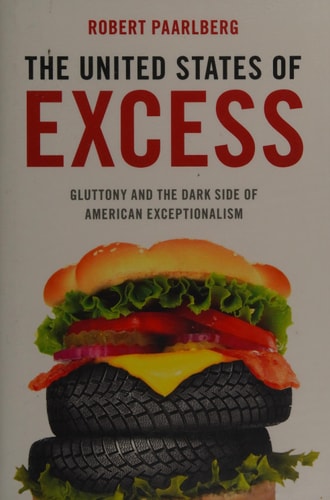
The United States of Excess: Gluttony and the Dark Side of American Exceptionalism
0
0
As an Amazon Associate and affiliate partner, Menrva Books earns from qualifying purchases. Learn more
Author Description
Compared to other wealthy countries, America stands out as a gluttonous over-consumer of both food and fuel. The United States boasts an obesity prevalence double the industrial world average, and per capita carbon emissions twice the average for Europe. Still worse, the policy steps taken by America in response to obesity and climate change have so far been the weakest in the industrial world. These aspects of America's exceptionalism are nothing to be proud of.Is it possible that America is hard-wired to consume too much food and fuel? Unfortunately, yes, says Robert Paarlberg in The United States of Excess. America's excess is driven in each case by its distinct endowment of material and demographic resources, its unusually weak national political institutions, and a unique political culture that celebrates both individual freedoms over social responsibility, and free markets over governmental authority. America's over-consumption is shown to be over-determined.Because of these powerful underlying circumstances, America's strongest policy response, both to climate change and obesity, will be adaptation rather than mitigation. As the damaging consequences of climate change become manifest, America will not impose adequate measures to reduce fossil fuel consumption, attempting instead to protect itself from storms and sea-level rise through costly infrastructure upgrades. In response to the damaging health consequences of obesity, America will opt for medical interventions and physical accommodations, rather than the policy measures that would be needed to induce better diets or more exercise.These adaptation responses will generate serious equity problems, both at home and abroad. Responding to obesity with medical interventions will fall short for those in America most prone to obesity - racial minorities and the poor - since these groups have never enjoyed adequate access to quality health care. Responding to climate change by building more resilient infrastruct
Menrva's Summary
THE THESIS
This book investigates whether the United States is structurally predisposed to excessive consumption of food and fuel, resulting in systemic failures to address obesity and climate change. Robert Paarlberg, a scholar of food and agricultural policy, utilizes comparative international data to analyze how American political institutions, resource endowments, and cultural values prioritize individual liberty and free-market autonomy over collective mitigation strategies. He argues that these foundational factors make adaptation, rather than prevention, the inevitable path for American policy.
THE SCOPE MAP
What You Will Find
- Comparative analysis of obesity rates and carbon emissions between the U.S. and other industrialized nations.
- Examination of how American political culture and weak institutional structures hinder regulatory intervention.
- Assessment of the shift from mitigation-based policy to adaptation-focused strategies in health and environmental sectors.
- Discussion of the socioeconomic equity implications for marginalized populations regarding healthcare and climate resilience.
THE AUTHORITY PERSPECTIVE
Experts recognize this work as a rigorous critique of American exceptionalism and its role in public health and environmental crises. Readers frequently note the clarity of the author's argument regarding the structural barriers to policy reform in the United States.
Page Count:
264
Publication Date:
2015-04-01
Publisher:
Oxford University Press
ISBN-10:
0199922624
ISBN-13:
9780199922628
Obesity
Health Policy
Energy policy
Medical policy
Sociology
American History
Public Policy
Food Consumption
United States
Community Tags
Similar Books