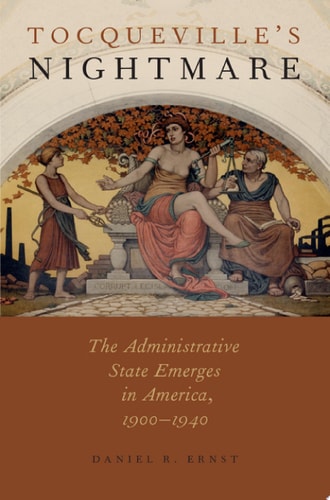
Tocqueville's Nightmare: The Administrative State Emerges in America, 1900-1940
0
0
As an Amazon Associate and affiliate partner, Menrva Books earns from qualifying purchases. Learn more
Author Description
In the 1830s, the French aristocrat Alexis de Tocqueville warned that "insufferable despotism" would prevail if America ever acquired a national administrative state. Today's Tea Partiers evidently believe that, after a great wrong turn in the early twentieth century, Tocqueville's nightmare has come true. In those years, it seems, a group of radicals, seduced by alien ideologies, created vast bureaucracies that continue to trample on individual freedom.In Tocqueville's Nightmare, Daniel R. Ernst destroys this ahistorical and simplistic narrative. He shows that, in fact, the nation's best corporate lawyers were among the creators of "commission government" that supporters were more interested in purging government of corruption than creating a socialist utopia, and that the principles of individual rights, limited government, and due process were built into the administrative state. Far from following "un-American" models, American state-builders rejected the leading European scheme for constraining government, the Rechtsstaat (a state of rules). Instead, they looked to an Anglo-American tradition that equated the rule of law with the rule of courts and counted on judges to review the bases for administrators' decisions. Soon, however, even judges realized that strict judicial review shifted to courts decisions best left to experts. The most masterful judges, including Charles Evans Hughes, Chief Justice of the United States from 1930 to 1941, ultimately decided that a "day in court" was unnecessary if individuals had already had a "day in commission" where the fundamentals of due process and fair play prevailed. This procedural notion of the rule of law not only solved the judges' puzzle of reconciling bureaucracy and freedom. It also assured lawyers that their expertise in the ways of the courts would remain valuable, and professional politicians that presidents would not use administratively distributed largess as an independent source of political power.
Menrva's Summary
THE THESIS
Does the emergence of the American administrative state between 1900 and 1940 represent a departure from constitutional principles or a logical evolution of the rule of law? Daniel R. Ernst, a professor of law and history, challenges the popular narrative that the administrative state was a radical, un-American imposition. By examining the legal and political developments of the early twentieth century, he argues that the creation of commission government was driven by corporate lawyers and reformers seeking to eliminate corruption while maintaining due process and judicial oversight.
THE SCOPE MAP
What You Will Find
- An analysis of the transition from traditional judicial governance to commission-based administrative authority.
- Examination of the role of corporate lawyers and legal professionals in shaping early federal bureaucracies.
- A comparative study of the American rejection of the European Rechtsstaat model in favor of Anglo-American procedural traditions.
- Historical evidence regarding the judicial philosophy of figures like Charles Evans Hughes and the evolution of due process standards.
THE AUTHORITY PERSPECTIVE
Legal historians and political scientists frequently cite this work as a critical corrective to simplistic narratives regarding the origins of American bureaucracy. Experts highlight the author's meticulous use of primary legal sources to demonstrate how the administrative state was integrated into, rather than opposed to, the existing American legal tradition.
Page Count:
240
Publication Date:
2014-01-01
Publisher:
Oxford University Press
ISBN-10:
0199920877
ISBN-13:
9780199920877
History
Professional Career & Trade
Rule Of Law
American History
Public Administration
Bureaucracy
Law
Government
Community Tags
Similar Books














