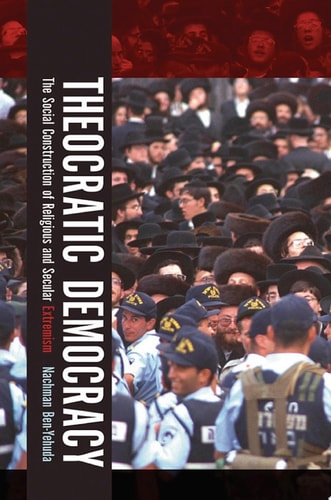
Theocratic Democracy: The Social Construction of Religious and Secular Extremism
0
0
As an Amazon Associate and affiliate partner, Menrva Books earns from qualifying purchases. Learn more
Author Description
The state of Israel was established in 1948 as a Jewish democracy, without a legal separation between religion and the state. Ever since, the tension between the two has been a central political, social, and moral issue in Israel, resulting in a cultural conflict between secular Jews and the fundamentalist, ultra-orthodox Haredi community. What is the nature of this cultural conflict and how is it managed? In Theocratic Democracy, Nachman Ben-Yehuda examines more than fifty years of media-reported unconventional and deviant behavior by members of the Haredi community. Ben-Yehuda finds not only that this behavior has happened increasingly often over the years, but also that its most salient feature is violence--a violence not random or precipitated by situational emotional rage, but planned and aimed to achieve political goals. Using verbal and non-verbal violence in the forms of curses, intimidation, threats, arson, stone-throwing, beatings, mass violations, and more, Haredi activists try to push Israel toward a more theocratic society. Driven by a theological notion that all Jews are mutually responsible and accountable to the Almighty, these activists believe that the sins of the few are paid for by the many. Making Israel a theocracy will, they believe, reduce the risk of transcendental penalties. Ben-Yehuda shows how the political structure that accommodates the strong theocratic and secular pressures Israel faces is effectively a theocratic democracy. Characterized by chronic negotiations, tensions, and accommodations, it is by nature an unstable structure. However, in his fascinating and lively account, Nachman Ben-Yehuda demonstrates how it allows citizens with different worldviews to live under one umbrella of a nation-state without tearing the social fabric apart.
Menrva's Summary
THE THESIS
This book investigates how the lack of legal separation between religion and state in Israel has fostered a unique, unstable political structure defined as a theocratic democracy. Nachman Ben-Yehuda, a sociologist, utilizes over fifty years of media reports and sociological data to analyze the escalating conflict between secular citizens and the ultra-orthodox Haredi community. He argues that the political system functions through chronic negotiation and accommodation, which prevents total social collapse despite the presence of religiously motivated violence.
THE SCOPE MAP
What You Will Find
- Longitudinal analysis of media-reported deviant behavior within the Haredi community.
- A framework for understanding the political utility of violence in religious activism.
- Examination of the theological justifications for collective responsibility and theocratic governance.
Scope Limits
- The study focuses primarily on the Israeli context and does not provide a comparative analysis of other theocratic democracies.
- The research relies heavily on media-reported incidents rather than direct ethnographic interviews with Haredi leadership.
THE AUTHORITY PERSPECTIVE
Scholars and political analysts recognize this work as a significant contribution to the study of Israeli social dynamics and the intersection of religious fundamentalism with democratic governance. Readers frequently note the academic rigor of the sociological framework while appreciating the author's ability to synthesize complex political tensions into a coherent narrative.
Page Count:
310
Publication Date:
2010-01-01
Publisher:
Oxford University Press
ISBN-10:
0190208406
ISBN-13:
9780190208400
Religion
Sociology
Extremism
Israel
Israel Studies
Radicalism
Jews
Special Topics
Jewish Studies
Religion and State
Community Tags
Similar Books