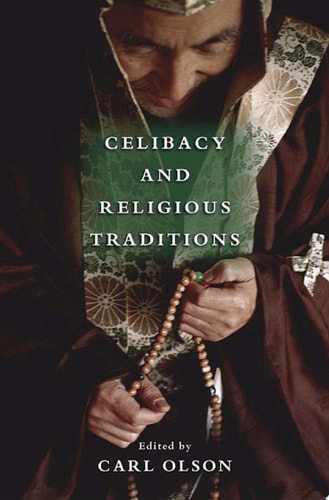
Celibacy & Religious Traditions
0
0
As an Amazon Associate and affiliate partner, Menrva Books earns from qualifying purchases. Learn more
Author Description
If sexuality is inherently social, the same thing can be said about celibacy. An understanding of celibacy, argues Carl Olson, can be a useful way to view the significance of the human body within a social context. The purpose of this book is to examine how the practice of celibacy differs cross-culturally as well as historically within a particular religious tradition. The essays (all previously unpublished) will demonstrate that celibacy is a complex religious phenomenon. The control of sexual desire can be used to divorce oneself from a basic human biological drive, to separate oneself from what is perceived as impure, or to distance oneself from a transient world. Within different religious traditions there can be found the practice of temporary celibacy, commitment to long-term permanent celibacy, and outright condemnations of it. By maintaining a state of virginity, members of some religious traditions imitate divine models; other traditions do not admit the possibility of emulating such paradigms. Whether or not a religious tradition encourages or discourages it, the practice of celibacy gives us insight into its worldview, social values, gender relations, ethics, religious roles, and understanding of the physical body. Celibacy can contribute to the creation of a certain status and play a role in the construction of identity, while serving as a source of charisma. In some religious traditions, it is possible to renounce sex and gain sacred status and economic support from society. Each essay in the collection will be written by an expert in a particular religious tradition. Each will address such questions as: Why do some members of a religious community decide to maintain a celibate style of religious life? Is celibacy a prerequisite for religious office or status? Are there different contexts within a given religious tradition for the practice of celibacy? What does the choice of celibacy tell us about the human body in a particular religious culture?
Menrva's Summary
THE THESIS
This collection of essays investigates how the practice of celibacy functions as a lens for understanding the significance of the human body and social identity within diverse religious traditions. Editor Carl Olson compiles original research from various scholars to examine the historical and cross-cultural variations of sexual renunciation. The text argues that celibacy is not a monolithic practice but a complex phenomenon that reflects a tradition's specific ethics, gender roles, and worldview. By analyzing the motivations behind both temporary and permanent celibacy, the contributors provide a framework for evaluating how religious communities construct status and charisma through the control of biological drives.
THE SCOPE MAP
What You Will Find
- Comparative analysis of celibacy across multiple global religious traditions
- Examination of the relationship between sexual renunciation and social status
- Exploration of the symbolic role of the body in religious identity construction
- Discussion of the economic and social implications of celibate lifestyles
Scope Limits
- The text does not provide a universal theory of human sexuality
- It does not offer a comprehensive history of every religious tradition in existence
THE AUTHORITY PERSPECTIVE
Scholars and students of religious studies frequently cite this collection as a useful resource for understanding the intersection of asceticism and social structure. Experts highlight the academic rigor of the individual essays and their effectiveness in demonstrating the diverse motivations behind religious celibacy.
Page Count:
336
Publication Date:
2007-01-01
Publisher:
Oxford University Press
ISBN-10:
019029437X
ISBN-13:
9780190294373
History
Religion
Anthropology
Ethics
Special Topics
Sociology
Community Tags
Similar Books