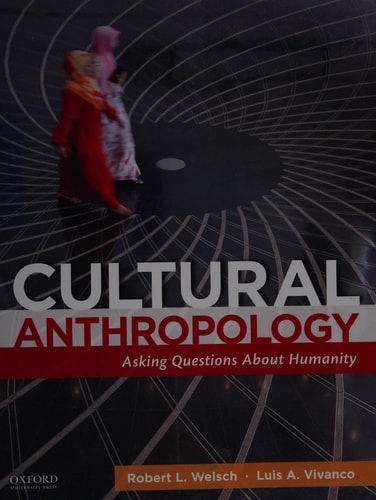
Cultural Anthropology: Asking Questions About Humanity
0
0
As an Amazon Associate and affiliate partner, Menrva Books earns from qualifying purchases. Learn more
Author Description
What is cultural anthropology, and how is it relevant in today's world?Robert L. Welsch and Luis A. Vivanco's Cultural Anthropology: Asking Questions About Humanity uses a questions-based approach to teach students how to think anthropologically, helping them view cultural issues and everyday experiences as an anthropologist might.Inspired by the common observation that 99 percent of a good answer is a good question, Cultural Anthropology: Asking Questions About Humanity combines a question-centered pedagogy with the topics typically covered in an introductory course. It emphasizes up front what the discipline of anthropology knows and which issues are in debate, and how a cultural perspective is relevant to understanding social, political, and economic dynamics in the contemporary world. Cultural Anthropology: Asking Questions About Humanity also represents an effort to close the gap between the realities of the discipline today and traditional views that are taught at the introductory level by bringing classic anthropological examples, cases, and analyses to bear on contemporary questions.
Menrva's Summary
THE THESIS
How can a question-based pedagogical framework effectively teach students to apply anthropological thinking to contemporary human experiences? Authors Luis A. Vivanco and Robert L. Welsch utilize their extensive academic backgrounds to bridge the divide between traditional anthropological theory and modern social realities. By structuring the text around inquiry rather than static facts, they provide a methodology that encourages students to analyze social, political, and economic dynamics through a critical cultural lens.
THE SCOPE MAP
What You Will Find
- A question-centered pedagogical framework for introductory anthropology.
- Integration of classic anthropological case studies with modern global issues.
- Analysis of contemporary social, political, and economic power structures.
- Methodologies for viewing everyday human experiences through an anthropological perspective.
THE AUTHORITY PERSPECTIVE
Educators and students frequently cite this text for its ability to modernize the introductory curriculum by prioritizing active inquiry over rote memorization. Experts highlight the book as a foundational resource for those seeking to understand the practical application of anthropological theory in a globalized world.
Page Count:
496
Publication Date:
2014-11-21
Publisher:
Oxford University Press
ISBN-10:
0199925720
ISBN-13:
9780199925728
Education
Anthropology
textbook
Social Science
Community Tags
Similar Books