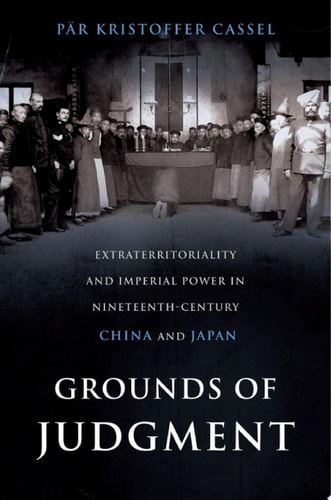
Grounds of Judgment: Extraterritoriality and Imperial Power in Nineteenth-Century China and Japan
0
0
As an Amazon Associate and affiliate partner, Menrva Books earns from qualifying purchases. Learn more
Author Description
Perhaps more than anywhere else in the world, the nineteenth century encounter between East Asia and the Western world has been narrated as a legal encounter. Commercial treaties--negotiated by diplomats and focused on trade--framed the relationships among Tokugawa-Meiji Japan, Qing China, Choson Korea, and Western countries including Britain, France, and the United States. These treaties created a new legal order, very different than the colonial relationships that the West forged with other parts of the globe, which developed in dialogue with local precedents, local understandings of power, and local institutions. They established the rules by which foreign sojourners worked in East Asia, granting them near complete immunity from local laws and jurisdiction. The laws of extraterritoriality looked similar on paper but had very different trajectories in different East Asian countries.Pär Cassel's first book explores extraterritoriality and the ways in which Western power operated in Japan and China from the 1820s to the 1920s. In Japan, the treaties established in the 1850s were abolished after drastic regime change a decade later and replaced by European-style reciprocal agreements by the turn of the century. In China, extraterritoriality stood for a hundred years, with treaties governing nearly one hundred treaty ports, extensive Christian missionary activity, foreign controlled railroads and mines, and other foreign interests, and of such complexity that even international lawyers couldn't easily interpret them. Extraterritoriality provided the springboard for foreign domination and has left Asia with a legacy of suspicion towards international law and organizations. The issue of unequal treaties has had a lasting effect on relations between East Asia and the West.Drawing on primary sources in Chinese, Japanese, Manchu, and several European languages, Cassel has written the first book to deal with exterritoriality in Sino-Japanese relations before 1895 and the tr
Menrva's Summary
THE THESIS
How did the implementation of extraterritoriality in nineteenth-century East Asia function as a distinct legal mechanism of imperial power rather than a uniform colonial imposition? Pär Kristoffer Cassel, a scholar of East Asian history, examines the divergent legal trajectories of Qing China and Tokugawa-Meiji Japan. By analyzing primary sources across multiple languages, he argues that these unequal treaties were not merely dictated by Western powers but were shaped by local institutions, existing legal precedents, and the specific political objectives of the host nations.
THE SCOPE MAP
What You Will Find
- Comparative analysis of legal frameworks in Qing China and Tokugawa-Meiji Japan from the 1820s to the 1920s.
- Examination of the role of treaty ports, missionary activity, and foreign-controlled infrastructure in the expansion of extraterritorial jurisdiction.
- Extensive use of primary source documentation in Chinese, Japanese, Manchu, and various European languages.
- Investigation into the long-term impact of unequal treaties on modern East Asian perceptions of international law and global organizations.
THE AUTHORITY PERSPECTIVE
Scholars recognize this work as a foundational text for understanding the intersection of legal history and imperialism in East Asia. Readers frequently note the academic density of the prose and the author's meticulous attention to multilingual archival evidence.
Page Count:
272
Publication Date:
2012-01-01
Publisher:
Oxford University Press
ISBN-10:
0199924287
ISBN-13:
9780199924288
History
Imperialism
Law
International relations
Diplomatic History
Legal History
Asian History
Community Tags
Similar Books