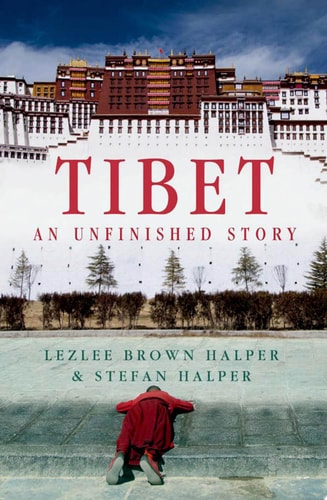
Tibet: An Unfinished Story
0
0
As an Amazon Associate and affiliate partner, Menrva Books earns from qualifying purchases. Learn more
Author Description
Tibet's enduring myth, animated by the tales of Himalayan adventurers, British military expeditions, and the novel, Lost Horizon, remains an inspirational fantasy, a modern morality play about the failure of brutality to subdue the human spirit. Tibet also exercises immense "soft power" as one of the lenses through which the world views China.This book traces the origins and manifestations of the Tibetan myth, as propagated by Younghusband, Madam Blavatsky, Himmler, Acheson and Roosevelt. The authors discuss how, after WW2, Tibet-- isolated, misunderstood and with a tiny elite unschooled in political-military realities --- misread the diplomacy between its two giant neighbours, India and China, forlornly hoping London or Washington might intervene. China's People's Liberation Army sought nothing less than to deconstruct traditional Tibet, unseat the Dalai Lama and "absorb" this vast region into the People's Republic, and Lhasa succumbed to China's invasion in 1950.Drawing on declassified CIA and Chinese documents, the authors reveal Mao's collusion with Stalin to subdue Tibet, double-dealing by Nehru, the brilliant diplomacy of Chou en Lai and how Washington see-sawed between the China lobby, who insisted there be no backing for an independent Tibet, and Presidents Truman and later Eisenhower, who initiated a covert CIA programme to support the Dalai Lama and resist Chinese occupation. It is an ignoble saga with few, if any, heroes, other than ordinary Tibetans.
Menrva's Summary
THE THESIS
This book investigates the historical origins of the Western myth surrounding Tibet and the complex geopolitical failures that led to its occupation by the People's Republic of China. The authors, Lezlee Brown Halper and Stefan Halper, utilize their expertise in international relations and history to analyze how romanticized perceptions of Tibet influenced global diplomacy. By examining the disconnect between Tibetan political isolation and the strategic interests of India, China, the United States, and the Soviet Union, the authors argue that the region became a casualty of Cold War maneuvering and miscalculated foreign policy.
THE SCOPE MAP
What You Will Find
- Analysis of the historical construction of the 'Tibetan myth' by figures such as Younghusband and Blavatsky.
- Examination of the diplomatic failures between Lhasa, New Delhi, and Beijing leading up to the 1950 invasion.
- Detailed account of the covert CIA programs initiated under the Truman and Eisenhower administrations.
- Documentation of the strategic collusion between Mao Zedong and Joseph Stalin regarding regional control.
Scope Limits
- The text does not provide an exhaustive cultural history of pre-modern Tibet.
- The narrative focus is primarily on high-level diplomatic and military strategy rather than the internal social history of the Tibetan populace.
THE AUTHORITY PERSPECTIVE
Experts and historians frequently cite this work for its rigorous use of declassified CIA and Chinese archival documents to demystify the geopolitical landscape of the mid-20th century. Readers often note the academic density of the prose, which provides a sobering, realistic counter-narrative to popular romanticized accounts of the region.
Page Count:
406
Publication Date:
2014-01-01
Publisher:
Oxford University Press
ISBN-10:
0190238011
ISBN-13:
9780190238018
History
International relations
Tibet China
Cold War
Asian History
Geopolitics
Community Tags
Similar Books