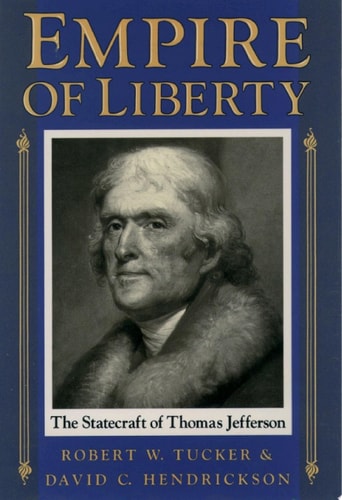
Empire of Liberty: The Statecraft of Thomas Jefferson
0
0
As an Amazon Associate and affiliate partner, Menrva Books earns from qualifying purchases. Learn more
Author Description
None of the founding fathers seems more elusive than Thomas Jefferson. A Virginian nationalist, a slave-holding philosophe, an aristocratic democrat, a provincial cosmopolitan, a pacific imperialist--the paradoxes loom as meaningful and portentous as America itself. Indeed, they represent the deep contradictions of his policies as well as personality, laid bare here in a provocative study of Jefferson's statecraft. Empire of Liberty takes a new look at the public life, thought, and ambiguous legacy of one of America's most revered statesmen, offering new insight into the meaning of Jefferson in the American experience. Robert Tucker and David Hendrickson vividly portray a complex man driven by his passion for liberty and his longing for a vast empire. They explore how Jefferson developed a new approach to diplomacy in the course of his bitter debates with Alexander Hamilton. This new diplomacy joined a policy of territorial and commercial expansion with a dread of war and a reliance on economic sanctions. It was with such an outlook that Jefferson met the two great crises of his presidency: the threat to American security posed by the French acquisition of Louisiana and the restrictions on American commerce prompted by the death struggle between Britain and France. The policy produced paradoxical success in the Louisiana crisis but led to complete failure in the form of the Embargo. Taken to escape the alternatives of national humiliation and war, the Embargo led first to humiliation and then, ultimately, to war. The system of war that Jefferson had hoped after hope to reform by the Embargo was not reformed. In the end, Jefferson came close to embracing measures which called into question almost every principle of government he professed to believe. Empire of Liberty examines Jefferson's legacy for American foreign policy in the light of several critical themes which continue to be highly significant today: the struggle between isolationists and interventionists.
Menrva's Summary
THE THESIS
How did Thomas Jefferson reconcile his philosophical commitment to liberty with the pragmatic requirements of imperial expansion and statecraft? Authors Robert Tucker and David Hendrickson analyze the contradictions inherent in Jefferson's political career, focusing on the tension between his idealistic rhetoric and the realities of governing a burgeoning nation. By examining his diplomatic strategies and responses to international crises, the authors provide a framework for understanding the origins of American foreign policy. The text utilizes historical records and correspondence to evaluate the effectiveness of Jefferson's reliance on economic sanctions versus military intervention.
THE SCOPE MAP
What You Will Find
- Analysis of the Louisiana Purchase and its impact on American territorial expansion.
- Examination of the diplomatic conflicts between Thomas Jefferson and Alexander Hamilton.
- Evaluation of the 1807 Embargo Act and its failure to prevent the War of 1812.
- Discussion of the enduring struggle between isolationist and interventionist ideologies in American governance.
THE AUTHORITY PERSPECTIVE
Historians and political scientists frequently cite this work as a critical examination of the paradoxes within Jeffersonian statecraft. The text is recognized for its balanced approach to assessing the successes and failures of early American foreign policy.
Page Count:
808
Publication Date:
2008-01-01
Publisher:
Oxford University Press
ISBN-10:
0199923450
ISBN-13:
9780199923458
History
Biography
English & College Success
Diplomacy
Biography Autobiography
English
American History
Community Tags
Similar Books