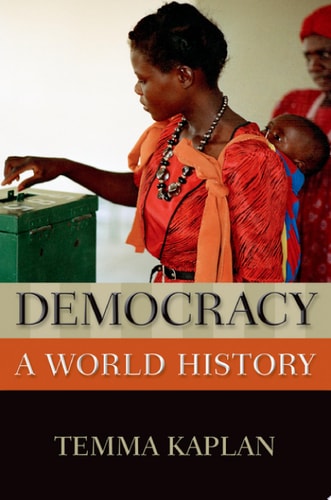
Democracy: A World History
0
0
As an Amazon Associate and affiliate partner, Menrva Books earns from qualifying purchases. Learn more
Author Description
In our time, the term "democracy" is frequently evoked to express aspirations for peace and social change or particular governmental systems that claim to benefit more than a select minority of the population. In this book, Temma Kaplan examines attempts from ancient Mesopotamia to the early twenty first century to create democratic governments that allow people to secure food, shelter, land, water, and peace for their mutual benefit.Since early times, proponents of direct or participatory democracy have come into conflict with the leaders of representative institutions that claim singular power over democracy. Patriots of one form or another have tried to reclaim the initiative to determine what democracy should mean and who should manage it. Frequently, people in small communities, trade unions, or repressed racial, religious, and political groups have marched forward using the language of democracy to carve a space for themselves and their ideas at the center of political life. Sometimes they have reinterpreted the old laws, and sometimes they have formulated new laws and institutions in order to gain greater opportunities to debate the major issues of their time.This book examines the development of the democratic ideal from ancient Rome to the Cortes in Spain, the philosophies of Guru Nanak and the Castilian patriot Juan de Padilla, and such inspirational personalities as the Polish trade unionist Anna Walentnyowicz and Burmese politician Aung San Suu Kyi. Though few democracies have sustained themselves for significant lengths of time, their emergence nearly everywhere on earth over thousands of years indicates their resilience despite the fragility of the democratic ideal.
Menrva's Summary
THE THESIS
This book investigates the historical evolution of democratic ideals and the persistent tension between participatory movements and centralized representative institutions across global civilizations. Temma Kaplan, a historian specializing in social movements and political change, utilizes a broad chronological and geographical framework to analyze how diverse groups have utilized the language of democracy to secure resources and political agency. The text argues that while democratic systems are often fragile and short-lived, the recurring emergence of these ideals across disparate cultures demonstrates their inherent resilience and adaptability.
THE SCOPE MAP
What You Will Find
- A historical survey spanning from ancient Mesopotamia and Rome to the early twenty-first century.
- Comparative analysis of diverse political structures including small communities, trade unions, and national governments.
- Case studies of influential figures such as Guru Nanak, Juan de Padilla, Anna Walentynowicz, and Aung San Suu Kyi.
- Examination of the conflict between direct participatory democracy and representative institutional power.
THE AUTHORITY PERSPECTIVE
Scholars and readers frequently note the book's expansive scope, which successfully synthesizes complex political history into a readable narrative. Experts highlight this as a useful introductory text for understanding the global and historical variations of democratic practice.
Page Count:
176
Publication Date:
2014-01-01
Publisher:
Oxford University Press
ISBN-10:
0199929963
ISBN-13:
9780199929962
History
Democracy
Special Topics
World history
Government
World Civilization
Community Tags
Similar Books