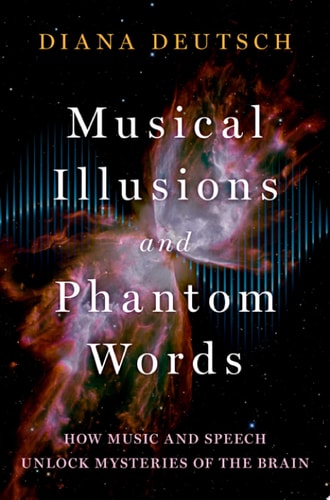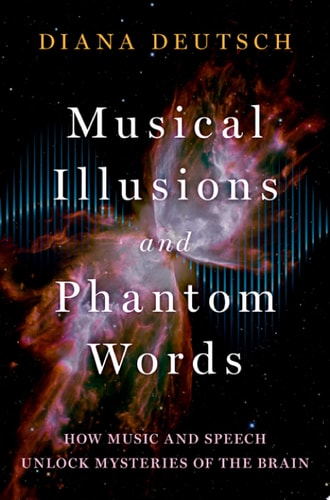
Musical Illusions and Phantom Words
0
0
As an Amazon Associate and affiliate partner, Menrva Books earns from qualifying purchases. Learn more
Author Description
In this ground-breaking synthesis of art and science, Diana Deutsch, one of the world's leading experts on the psychology of music, shows how illusions of music and speech--many of which she herself discovered--have fundamentally altered thinking about the brain. These astonishing illusions show that people can differ strikingly in how they hear musical patterns--differences that reflect variations in brain organization as well as influences of language on music perception. Drawing on a wide variety of fields, including psychology, music theory, linguistics, and neuroscience, Deutsch examines questions such as: When an orchestra performs a symphony, what is the real music? Is it in the mind of the composer, or the conductor, or different members of the audience? Deutsch also explores extremes of musical ability, and other surprising responses to music and speech. Why is perfect pitch so rare? Why do some people hallucinate music or speech? Why do we hear phantom words and phrases? Why are we subject to stuck tunes, or earworms? Why do we hear a spoken phrase as sung just because it is presented repeatedly? In evaluating these questions, she also shows how music and speech are intertwined, and argues that they stem from an early form of communication that had elements of both. Many of the illusions described in the book are so striking and paradoxical that you need to hear them to believe them. The book enables you to listen to the sounds that are described while reading about them.
Menrva's Summary
THE THESIS
How do the auditory illusions we experience reveal the underlying mechanisms of human brain organization and the shared evolutionary roots of music and speech? Diana Deutsch, a prominent researcher in the psychology of music, synthesizes decades of experimental data to argue that our perception of sound is not a passive recording of reality but an active construction by the brain. By examining auditory anomalies, she demonstrates that individual differences in hearing patterns reflect distinct neurological structures and linguistic influences.
THE SCOPE MAP
What You Will Find
- Analysis of auditory illusions including phantom words, scale illusions, and the speech-to-song effect.
- Exploration of the neurological basis for perfect pitch and musical hallucinations.
- Investigation into the cognitive mechanisms behind earworms and repetitive sound perception.
- Integration of data from psychology, music theory, linguistics, and neuroscience.
Scope Limits
- The text does not provide a comprehensive history of musicology or music composition.
- It does not offer clinical treatments for auditory disorders or hallucinations.
THE AUTHORITY PERSPECTIVE
Experts recognize this work as a foundational text for understanding the intersection of auditory perception and cognitive neuroscience. Readers frequently note that the inclusion of audio examples makes the complex technical concepts accessible to both students and interested laypeople.
Page Count:
272
Publication Date:
2019-01-01
Publisher:
Oxford University Press
ISBN-10:
0190206845
ISBN-13:
9780190206840
Psychology
Linguistics
Music theory
Acoustics
Neuroscience
Community Tags
Similar Books