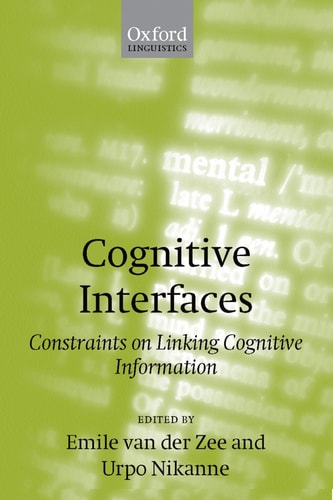
Cognitive Interfaces: Constraints on Linking Cognitive Information
0
0
As an Amazon Associate and affiliate partner, Menrva Books earns from qualifying purchases. Learn more
Author Description
This book brings new perspectives to bear on the architecture of the mind and the relationship between language and cognition. It considers how information is linked in the mind between different cognitive and expressive levels - so that people can, for example, talk about what they see and act upon what they hear - and how these linkages are and need to be constrained. The book is concerned in particular with the perception and representation of spatial structure. The authors, all psychologists and linguists, show that insights can be gained from the joint deployment of theoretical linguistic and experimental psychological research and the value of a multi-disciplinary approach to the study of mind, brain, and language.
Menrva's Summary
THE THESIS
This volume investigates the mechanisms and constraints governing how cognitive information is linked across different mental and expressive levels. The authors, Emile van de Zee and Urpo Nikanne, assemble a collection of research from psychologists and linguists to examine the architecture of the mind. By focusing on the intersection of language and cognition, the text argues for a multi-disciplinary approach to understanding how humans translate sensory input into conceptual representation and linguistic output.
THE SCOPE MAP
What You Will Find
- Theoretical frameworks for the architecture of the mind and cognitive linking.
- Analysis of the perception and representation of spatial structure.
- Experimental psychological research integrated with linguistic theory.
- Methodologies for studying the relationship between brain, language, and cognition.
THE AUTHORITY PERSPECTIVE
Experts recognize this work as a significant contribution to the interdisciplinary study of cognitive linguistics and mental architecture. Readers frequently note the academic density of the prose, which serves as a foundational text for scholars interested in the intersection of spatial cognition and language processing.
Page Count:
272
Publication Date:
2001-04-12
Publisher:
Oxford University Press
ISBN-10:
0198299621
ISBN-13:
9780198299622
Psychology
Neuroscience
Cognitive Psychology
Computer Interfaces
Linguistics