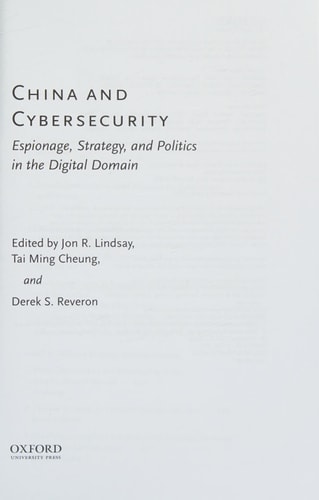
China and Cybersecurity: Espionage, Strategy, and Politics in the Digital Domain
0
0
As an Amazon Associate and affiliate partner, Menrva Books earns from qualifying purchases. Learn more
Author Description
China's emergence as a great power in the twenty-first century is strongly enabled by cyberspace. Leveraged information technology integrates Chinese firms into the global economy, modernizes infrastructure, and increases internet penetration which helps boost export-led growth. China's pursuit of "informatization" reconstructs industrial sectors and solidifies the transformation of the Chinese People's Liberation Army into a formidable regional power. Even as the government censors content online, China has one of the fastest growing internet populations and most of the technology is created and used by civilians.Western political discourse on cybersecurity is dominated by news of Chinese military development of cyberwarfare capabilities and cyber exploitation against foreign governments, corporations, and non-governmental organizations. Western accounts, however, tell only one side of the story. Chinese leaders are also concerned with cyber insecurity, and Chinese authors frequently note that China is also a victim of foreign cyber -- attacks -- predominantly from the United States.China and Cybersecurity: Espionage, Strategy, and Politics in the Digital Domain is a comprehensive analysis of China's cyberspace threats and policies. The contributors -- Chinese specialists in cyber dynamics, experts on China, and experts on the use of information technology between China and the West -- address cyberspace threats and policies, emphasizing the vantage points of China and the U.S. on cyber exploitation and the possibilities for more positive coordination with the West. The volume's multi-disciplinary, cross-cultural approach does not pretend to offer wholesale resolutions. Contributors take different stances on how problems may be analyzed and reduced, and aim to inform the international audience of how China's political, economic, and security systems shape cyber activities. The compilation provides empirical and evaluative depth on the deepening dependence on shared
Menrva's Summary
THE THESIS
This volume investigates how China's domestic political, economic, and security systems shape its cyber activities and influence its interactions with the global digital domain. The authors, including Derek S. Reveron, Jon R. Lindsay, and Tai Ming Cheung, assemble a multidisciplinary team of experts to examine the dual nature of China's cyber posture. By balancing perspectives from both Chinese and Western observers, the text argues that China's cyber strategy is driven as much by internal concerns regarding insecurity and informatization as it is by external ambitions in espionage and military modernization.
THE SCOPE MAP
What You Will Find
- Analysis of the Chinese People's Liberation Army's transformation through informatization.
- Examination of the tension between civilian internet growth and state-led censorship.
- Comparative study of cyber exploitation tactics from both Chinese and U.S. vantage points.
- Discussion on the potential for international coordination and policy reduction of cyber threats.
Scope Limits
- The text does not provide wholesale resolutions or definitive policy solutions for global cyber conflicts.
- The analysis focuses primarily on the strategic and political dimensions rather than deep technical forensic breakdowns of specific malware or code.
THE AUTHORITY PERSPECTIVE
Experts and academics frequently cite this volume as a foundational text for understanding the nuanced motivations behind China's cyber policies. Readers note the academic density of the prose, which provides a balanced, cross-cultural framework for analyzing complex international digital security issues.
Page Count:
398
Publication Date:
2015-01-01
Publisher:
Oxford University Press
ISBN-10:
0190201266
ISBN-13:
9780190201265
Military Strategy
National security
Cybersecurity
International Cooperation
International relations
China Studies
Community Tags
Other Editions(2)

Similar Books









Reader Comments
Share Your Thoughts
No comments yet. Be the first to share your thoughts!