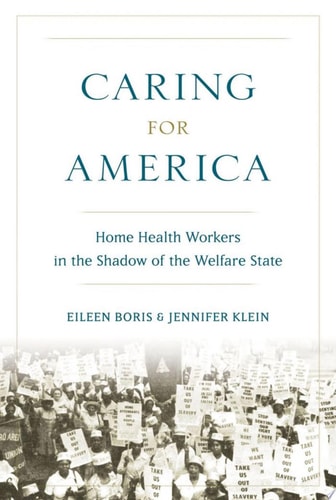
Caring for America: Home Health Workers in the Shadow of the Welfare State
0
0
As an Amazon Associate and affiliate partner, Menrva Books earns from qualifying purchases. Learn more
Author Description
In this sweeping narrative history from the Great Depression of the 1930s to the Great Recession of today, Caring for America rethinks both the history of the American welfare state from the perspective of care work and chronicles how home care workers eventually became one of the most vibrant forces in the American labor movement. Eileen Boris and Jennifer Klein demonstrate the ways in which law and social policy made home care a low-waged job that was stigmatized as welfare and relegated to the bottom of the medical hierarchy. For decades, these front-line caregivers labored in the shadows of a welfare state that shaped the conditions of the occupation. Disparate, often chaotic programs for home care, which allowed needy, elderly, and disabled people to avoid institutionalization, historically paid poverty wages to the African American and immigrant women who constituted the majority of the labor force. Yet policymakers and welfare administrators linked discourses of dependence and independence-claiming that such jobs would end clients' and workers' "dependence" on the state and provide a ticket to economic independence. The history of home care illuminates the fractured evolution of the modern American welfare state since the New Deal and its race, gender, and class fissures. It reveals why there is no adequate long-term care in America.Caring for America is much more than a history of social policy, however; it is also about a powerful contemporary social movement. At the front and center of the narrative are the workers-poor women of color-who have challenged the racial, social, and economic stigmas embedded in the system. Caring for America traces the intertwined, sometimes conflicting search of care providers and receivers for dignity, self-determination, and security. It highlights the senior citizen and independent living movements; the civil rights organizing of women on welfare and domestic workers; the battles of public sector unions; and the unionization.
Menrva's Summary
THE THESIS
This book investigates how the evolution of the American welfare state from the 1930s to the present has systematically marginalized home health workers through low wages and social stigma. Eileen Boris and Jennifer Klein, both established scholars in labor and gender history, utilize a vast array of archival data and policy analysis to argue that the current crisis in long-term care is a direct result of historical race, gender, and class fissures. They demonstrate how policymakers intentionally relegated care work to the bottom of the medical hierarchy, effectively trapping a predominantly female and immigrant workforce in a cycle of economic instability.
THE SCOPE MAP
What You Will Find
- A comprehensive historical analysis of the American welfare state from the Great Depression to the Great Recession.
- Examination of the intersectional impact of race, gender, and class on labor policy.
- Documentation of the rise of home care worker movements and their integration into the broader labor movement.
- Analysis of the tension between state-mandated independence and the reality of poverty-level wages for caregivers.
THE AUTHORITY PERSPECTIVE
Scholars and labor historians frequently cite this work as a foundational text for understanding the structural failures of the American care economy. Readers often note the academic rigor and the depth of the authors' research into the intersection of social policy and labor activism.
Page Count:
318
Publication Date:
2012-01-01
Publisher:
Oxford University Press
ISBN-10:
0199939055
ISBN-13:
9780199939053
History
Labor
History of the Americas
United States
American History
Public Policy
Sociology
Human services
Community Tags
Similar Books















Reader Comments
Share Your Thoughts
No comments yet. Be the first to share your thoughts!