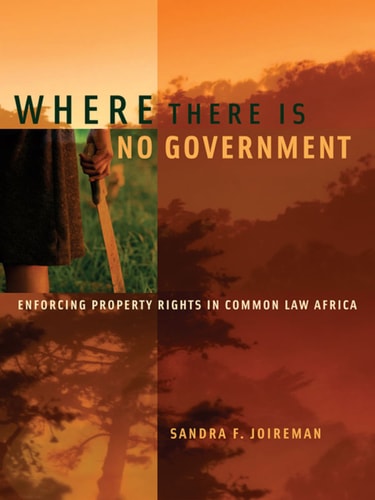
Where There is No Government: Enforcing Property Rights in Common Law Africa
0
0
As an Amazon Associate and affiliate partner, Menrva Books earns from qualifying purchases. Learn more
Author Description
It is safe to say that a sizeable majority of the world's population would agree with the proposition that that property rights are important for political and social stability as well as economic growth. But what happens when the state fails to enforce such rights? Throughout sub-Saharan Africa, this is in fact an endemic problem. In Where There is No Government, Sandra Joireman explains how weak state enforcement regimes have allowed private institutions in sub-Saharan Africa to define and enforce property rights. After delineating the types of actors who step in when the state is absent--traditional tribal leaders, entrepreneurial bureaucrats, NGOs, and violent groups--she argues that the institutions they develop can be helpful or predatory depending on their incentives and context. Because such institutions are neither inherently good nor inherently bad, Joireman develops a set of measurement criteria to assess which types of property regimes and enforcement mechanisms are helpful and which are harmful to social welfare.By focusing on the varieties of property rights enforcement in Ghana, Kenya and Uganda, Joireman moves beyond simply evaluating the effectiveness of official property rights laws. Provocatively, she also challenges the premise that changes in property law will lead to changes in property rights on the ground. Indeed, states that change their property laws face challenges in implementation when they do not control the authority structures in local communities. Utilizing original research on the competitors to state power in Sub-Saharan Africa and the challenges of providing secure and defensible property rights, Where There is No Government is a sharp analysis of one of the most daunting challenges facing the African subcontinent today.
Menrva's Summary
THE THESIS
This book investigates how property rights are enforced in sub-Saharan African nations where state institutions are weak or absent. Sandra F. Joireman, a scholar of political science and African development, utilizes original field research and comparative analysis to examine the non-state actors who fill the enforcement vacuum. She argues that these alternative institutions—ranging from traditional leaders to predatory groups—are not inherently beneficial or harmful, but rather function based on their specific incentives and local contexts.
THE SCOPE MAP
What You Will Find
- Comparative analysis of property rights enforcement in Ghana, Kenya, and Uganda.
- A typology of non-state actors including tribal leaders, NGOs, and entrepreneurial bureaucrats.
- A framework of measurement criteria to assess the social welfare impact of various property regimes.
Scope Limits
- The study does not provide a comprehensive legal history of all African nations.
- It does not offer a universal policy solution for state-building or legislative reform.
THE AUTHORITY PERSPECTIVE
Experts in African political economy highlight this work as a significant contribution to understanding the gap between formal legal statutes and local enforcement realities. Readers frequently note the academic rigor of the text, which serves as a foundational resource for those studying institutional development and governance in the Global South.
Page Count:
223
Publication Date:
2011-01-01
Publisher:
Oxford University Press
ISBN-10:
0190208465
ISBN-13:
9780190208462
Economics
Law
Public Policy
Professional Career & Trade
Land tenure
property rights
Community Tags
Similar Books