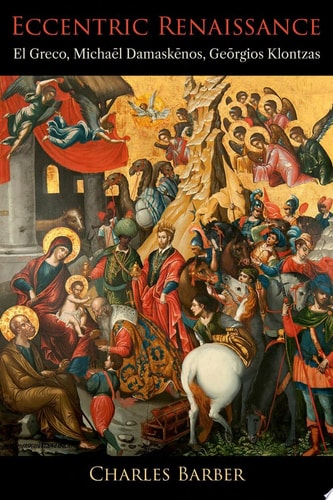
Eccentric Renaissance: El Greco, Michael Damaskenos, Georgios Klontzas
0
0
As an Amazon Associate and affiliate partner, Menrva Books earns from qualifying purchases. Learn more
Author Description
The Byzantine icon has long remained marginal to the study of art's history, only emerging from Giorgio Vasari's condemnation of the gilded, unnatural style of Byzantine painting (maniera greca) when his theories were challenged in the early twentieth century. Eccentric Renaissance focuses on an earlier reaction to Vasari's narrative and discusses three artists who shaped distinct responses to the hegemonic sway of sixteenth-century Italian art. Domenikos Theotokopoulos (more familiarly known as El Greco), Michael Damaskenos, and Georgios Klontzas were contemporary icon painters on the Venetian colony of Crete. Trained in the rich tradition of Cretan painting, these artists differed from their forebears in asserting a self-conscious creativity in their work. They renewed the art of icon painting in the context of Venetian colonialism by reconsidering how their art might address the contemporary world.Deemed eccentric, El Greco's work presented a Greek path contrary to the one promoted in Vasari's history of art. His was an art that was sensual, complex, and difficult. Michael Damaskenos's profound engagement with Venetian painting was mixed with traditional iconic styles, reflecting life in a colony in which Orthodox and Catholic, Greek and Venetian were fluid rather than static descriptors of the self. Georgios Klontzas used his art to confront the horrors of his day. The impending threat of the Ottoman conquest of Crete and the outbreak of plague in 1592 shaped his extraordinary manuscript, Apocalypse and History, that sought to understand these calamities in light of both divine providence and human experience. Each of these artists chose an eccentric point of departure for their work. Greek, colonized, and fearful, they invite us to look again and to look differently at the later sixteenth century.
Menrva's Summary
THE THESIS
This book investigates how three Cretan artists—El Greco, Michael Damaskenos, and Georgios Klontzas—challenged the prevailing Vasarian narrative of Renaissance art by asserting a self-conscious, distinctively Greek creativity within the context of Venetian colonialism. Charles Barber, a scholar of Byzantine and medieval art, utilizes historical analysis and art criticism to examine how these painters navigated the fluid cultural boundaries between Orthodox and Catholic identities. By focusing on their specific responses to sixteenth-century Italian hegemony, the author argues that these artists developed an 'eccentric' path that redefined the possibilities of icon painting.
THE SCOPE MAP
What You Will Find
- Analysis of sixteenth-century Cretan icon painting traditions
- Examination of the cultural intersection between Venetian colonialism and Greek identity
- Case studies of El Greco, Michael Damaskenos, and Georgios Klontzas
- Discussion of the manuscript 'Apocalypse and History' in relation to plague and Ottoman threats
Scope Limits
- The text does not provide a comprehensive survey of all Cretan artists of the period
- The analysis is limited to the specific 'eccentric' responses to Vasari's art historical framework
THE AUTHORITY PERSPECTIVE
Scholars and art historians recognize this work as a significant contribution to the re-evaluation of Byzantine influence within the broader Renaissance canon. Readers frequently note the academic rigor of the prose and the author's ability to synthesize complex historical contexts with detailed visual analysis.
Page Count:
336
Publication Date:
2024-11-01
Publisher:
Oxford University Press
ISBN-10:
0190209003
ISBN-13:
9780190209001
Biography
History
Politics
Cultural History
Art History
Byzantine Art
Europe
Specific Topics
Community Tags
Similar Books