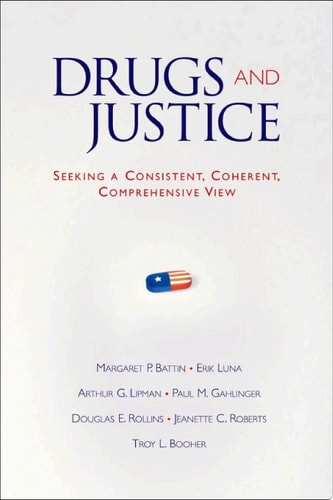
Drugs and Justice: Seeking a Consistent, Coherent, Comprehensive View
0
0
As an Amazon Associate and affiliate partner, Menrva Books earns from qualifying purchases. Learn more
Author Description
This compact and innovative book tackles one of the central issues in drug policy: the lack of a coherent conceptual structure for thinking about drugs. Drugs generally fall into one of seven categories: prescription, over the counter, alternative medicine, common-use drugs like alcohol, tobacco and caffeine; religious-use, sports enhancement; and of course illegal street drugs like cocaine and marijuana. Our thinking and policies varies wildly from one to the other, with inconsistencies that derive more from cultural and social values than from medical or scientific facts. Penalties exist for steroid use, while herbal remedies or cold medication are legal. Native Americans may legally use peyote, but others may not. Penalties may vary for using different forms of the same drug, such as crack vs. powder cocaine. Herbal remedies are unregulated by the FDA; but medical marijuana is illegal in most states. Battin and her contributors lay a foundation for a wiser drug policy by promoting consistency and coherency in the discussion of drug issues and by encouraging a unique dialogue across disciplines. The contributors are an interdisciplinary group of scholars mostly based at the University of Utah, and include a pharmacologist, a psychiatrist, a toxicologist, a trial court judge, a law professor, an attorney, a diatary specialist, a physician, a health expert on substance abuse, and Battin herself who is a philosopher. They consider questions like the historical development of current policy and the rationales for it; scientific views on how drugs actually cause harm; how to define the key notions of harm and addiction; and ways in which drug policy can be made more consistent. They conclude with an examination of the implications of a consistent policy for various disciplines and society generally. The book is written accessibly with little need for expert knowledge, and will appeal to a diverse audience of philosophers, bioethicists, clinicians, policy makers, law en
Menrva's Summary
THE THESIS
This book investigates the fundamental lack of a coherent conceptual framework in current drug policy, arguing that existing regulations are driven more by cultural values than by scientific evidence. The authors, an interdisciplinary team of scholars from the University of Utah including pharmacologists, legal experts, and philosophers, utilize a multi-disciplinary approach to analyze the inconsistencies in how society categorizes and penalizes various substances. By examining the historical development of policy and the definitions of harm and addiction, they propose a more rational and consistent model for future drug legislation.
THE SCOPE MAP
What You Will Find
- A classification system for seven distinct categories of drugs, ranging from prescription to illegal street substances.
- An interdisciplinary analysis of drug policy through the lenses of law, medicine, and philosophy.
- A critical examination of the discrepancies in legal treatment for substances like crack versus powder cocaine or peyote.
Scope Limits
- The text does not provide a comprehensive legal manual for specific state-by-state drug statutes.
- It does not offer a clinical treatment guide for substance abuse disorders.
THE AUTHORITY PERSPECTIVE
Experts and readers frequently note that the book serves as a valuable bridge between academic disciplines, making complex policy issues accessible to a broad audience. The text is recognized for its ability to synthesize diverse professional perspectives into a clear, unified argument for policy reform.
Page Count:
308
Publication Date:
2007-01-01
Publisher:
Oxford University Press
ISBN-10:
0190207647
ISBN-13:
9780190207649
Philosophy
Pharmacology
Ethics
Physicians
Sociology
Medical
Pharmacy
Law
Toxicology
Drug control
Allied Health
Professional Career & Trade
Public Policy
Law And Legislation
Community Tags
Similar Books







Reader Comments
Share Your Thoughts
No comments yet. Be the first to share your thoughts!