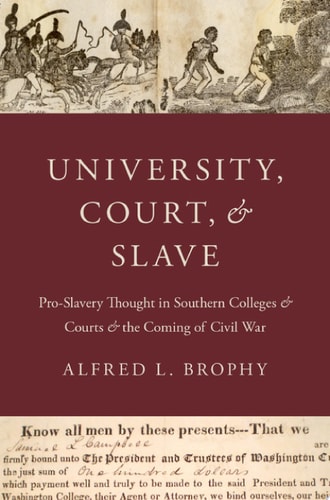
University, Court, and Slave
0
0
As an Amazon Associate and affiliate partner, Menrva Books earns from qualifying purchases. Learn more
Author Description
University, Court, And Slave Reveals Long-forgotten Connections Between Pre-civil War Southern Universities And Slavery. Universities And Their Faculty Owned People-sometimes Dozens Of People-and Profited From Their Labor While Many Slaves Endured Physical Abuse On Campuses. As Alfred L. Brophy Shows, Southern Universities Fought The Emancipation Movement For Economic Reasons, But Used Their Writings On History, Philosophy, And Law In An Attempt To Justify Their Position And Promote Their Institutions. Indeed, As The Antislavery Movement Gained Momentum, Southern Academics And Their Allies In The Courts Became Bolder In Their Claims. Some Went So Far As To Say That Slavery Was Supported By Natural Law. The Combination Of Economic Reasoning And Historical Precedent Helped Shape A Southern, Pro-slavery Jurisprudence. Following Lincoln's November 1860 Election, Southern Academics Joined Politicians, Judges, Lawyers, And Other Leaders In Arguing That Their Economy And Society Was Threatened. Southern Jurisprudence Led Them To Believe That Any Threats To Slavery And Property Justified Secession. Bolstered By The Courts, Academics Took Their Case To The Southern Public-and Ultimately To The Battlefield-to Defend Slavery. A Path-breaking And Deeply Researched History Of Southern Universities' Investment In And Defense Of Slavery, University, Court, And Slave Will Fundamentally Transform Our Understanding Of The Institutional Foundations Pro-slavery Thought.
Menrva's Summary
THE THESIS
This book investigates the historical entanglement between Southern universities and the institution of slavery, questioning how academic and legal frameworks were utilized to justify the practice. Alfred L. Brophy, a legal scholar, utilizes extensive archival research to document how faculty and institutions not only owned enslaved people but also actively constructed intellectual defenses for slavery. By analyzing the intersection of economic interests and academic discourse, the author demonstrates how Southern universities provided the ideological scaffolding for pro-slavery jurisprudence leading up to the Civil War.
THE SCOPE MAP
What You Will Find
- Historical analysis of university faculty and institutional slave ownership in the pre-Civil War South.
- Examination of how legal, historical, and philosophical writings were weaponized to support slavery.
- Documentation of the transition from academic defense of slavery to the political justification for secession.
- Case studies illustrating the collaboration between Southern academics and the judicial system.
THE AUTHORITY PERSPECTIVE
Scholars and historians recognize this work as a significant contribution to the study of institutional complicity in the American South. Readers frequently note the meticulous archival detail and the clarity with which Brophy connects academic theory to the political realities of the nineteenth century.
Page Count:
416
Publication Date:
2016-01-01
Publisher:
Oxford University Press
ISBN-10:
0199964246
ISBN-13:
9780199964246
History
Education
Slavery
Legal History
American History
Southern History
Community Tags
Similar Books