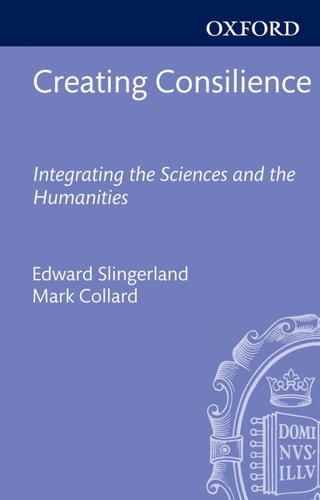
Creating Consilience: Integrating the Sciences and the Humanities
0
0
As an Amazon Associate and affiliate partner, Menrva Books earns from qualifying purchases. Learn more
Author Description
Calls for a "consilient" or "vertically integrated" approach to the study of human mind and culture have, for the most part, been received by scholars in the humanities with either indifference or hostility. One reason for this is that consilience has often been framed as bringing the study of humanistic issues into line with the study of non-human phenomena, rather than as something to which humanists and scientists contribute equally. The other major reason that consilience has yet to catch on in the humanities is a dearth of compelling examples of the benefits of adopting a consilient approach. Creating Consilience is the product of a workshop that brought together internationally-renowned scholars from a variety of fields to address both of these issues. It includes representative pieces from workshop speakers and participants that examine how adopting such a consilient stance -- informed by cognitive science and grounded in evolutionary theory -- would concretely impact specific topics in the humanities, examining each topic in a manner that not only cuts across the humanities-natural science divide, but also across individual humanistic disciplines. By taking seriously the fact that science-humanities integration is a two-way exchange, this volume takes a new approach to bridging the cultures of science and the humanities. The editors and contributors formulate how to develop a new shared framework of consilience beyond mere interdisciplinarity, in a way that both sides can accept.
Menrva's Summary
THE THESIS
This volume investigates the feasibility and methodology of achieving a 'consilient' integration between the natural sciences and the humanities to create a shared framework for studying human culture. Editors Edward Slingerland and Mark Collard, both established scholars in cognitive science and evolutionary anthropology, curate a collection of essays from international experts. The work argues that previous attempts at integration failed due to a perceived hierarchy favoring the sciences, and it proposes a reciprocal model where humanists and scientists contribute equally to the study of the human mind.
THE SCOPE MAP
What You Will Find
- Theoretical frameworks for vertical integration of humanistic and scientific inquiry
- Case studies applying evolutionary theory to specific humanistic disciplines
- Methodologies for cross-disciplinary collaboration beyond traditional interdisciplinarity
- Arguments addressing the historical resistance of humanities scholars toward scientific reductionism
Scope Limits
- Does not provide a singular, unified theory of everything for all academic disciplines
- Does not cover the entirety of the history of science-humanities debates
THE AUTHORITY PERSPECTIVE
Scholars and academics frequently cite this text as a significant attempt to move beyond the 'two cultures' divide by proposing a collaborative rather than imperialistic model of integration. Experts note that the volume is dense and intended primarily for an academic audience interested in the intersection of cognitive science and cultural studies.
Page Count:
474
Publication Date:
2011-01-01
Publisher:
Oxford University Press
ISBN-10:
019020799X
ISBN-13:
9780190207991
Science
Philosophy
Mind & Body
Science
Interdisciplinary Studies
Humanities
Science and Humanities
Evolutionary Theory
Philosophy of
Community Tags
Similar Books